Professor Hilary Carey University of Bristol 8th November 2023
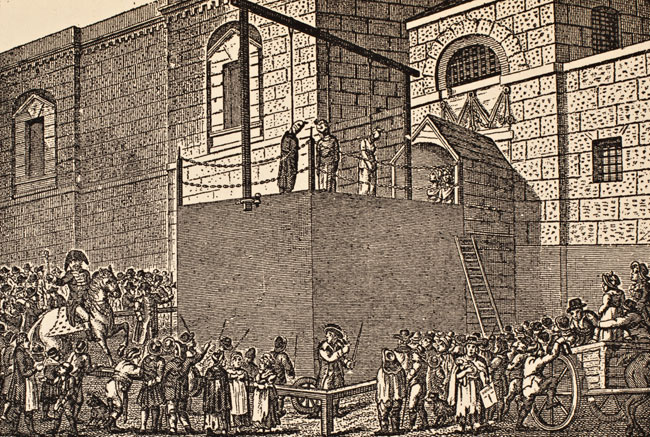
Professor Carey gave a fascinating lecture on the special execution sermons given by prison chaplains known as ordinaries each Sunday at Newgate Prison before the public executions of condemned prisoners. Her lecture covered the period 1789-1868 during which 657 souls were executed. She explained the duties of the “ordinaries” who were relatively well paid prison chaplains. The nature of the sermons they gave. How prisoners behaved showing penitence or resistance to these execution sermons and how the practice was reformed and eventually abolished. During the office of two ordinaries Brownlow Forde and Horace Cotton there were 548 executions.
These executions were very different from our pre-conceptions of hangings. Often, they were done in batches with six condemned prisoners for various offences all executed at once. The crowds at these executions were often large. In 1868 200 Irish turned up for the execution of a Fenian (Michael Barrett) who almost escaped into the crowd. Common offences were what today would be called “white collar” crimes like forgeries or utterers who passed on forged notes. Murderers were allowed to exempt themselves from the sermons but those prisoners who attended were grouped around a coffin. As well as their families the congregation for the sermon paid tickets to attend and were often made up of bankers from the City of London. Professor Carey used 19th century newspapers including the reports of the young Charles Dickens (Boz) to gain the texts of these sermons. Clearly the public had a taste for reading about these crimes and executions. Her visual sources included prints by Hogarth and the ‘Microcosm of London’ illustrated by Thomas Rowlandson. The penitence and resistance of prisoners was fascinating. The Cato Street conspirators (1820), all atheists refused to recognise the authority of the courts, the sermon or the executioner. Other prisoners showed conspicuous piety seizing the coffin at the sermon and declaring their regrets. Others dressed in white like martyrs. The logic behind the penitence was that some of these prisoners’ sentences were commuted even at the last minute on the scaffold.
The last public execution took place at Newgate in 1868 but it would be another 96 years before execution in Britain would be abolished. Our audience as usual supplied some thought provoking questions.

 Bristol Historical Association