Review of Professor William Doyle’s Lecture on The American and French Revolution and their links, similarities, and differences

10th June 2026

Our final lecture of 2025-26 began with a friendly drink for members, guests and local students.  Mary gave some details of next year’s programme and we had a strong audience of 107 in the beautiful Reception Room at the Wills Building.

Professor Doyle began by explaining how much the word ‘revolution’ had itself changed its meaning after 1789 from a political change to something much more profound.  According to Robespierre ‘The French Revolution is the first to have been founded on the theory of the rights of humanity, and on the principles of justice’ So was the American Revolution about home rule, or who should rule at home? However, the statement of the American Declaration of Independence suggested a similar profound change. The Founding Fathers  statement that they  ‘that all men are created equal, and that they are endowed by their Creator with certain inalienable rights, that among these are life, liberty, and the pursuit of happiness’ predated the French revolution by over a decade. 

Professor Doyle traced the new American State’s relationship with France.  We learnt how the French foreign secretary (Vergennes) sought to humiliate England by supporting the Americans in the War of Independence which put a great strain on the French economy.  Meanwhile Benjamin Franklin, America’s first Ambassador in Paris (1778-85)  , charmed and cultivated French Society and his successor Jefferson continued the propaganda since the French ‘know nothing about us here.’ This America Mania unsettled French politics and ultimately wrecked the French economy while bringing few benefits in terms of trade. Its military intervention cost France around three times its annual tax revenue.  The financial crisis led the Ancien Regime to bankruptcy in 1788 and forced the government to call the Estates General in 1789 which led to the Revolution!

So if the French Government’s support for the American Revolutionaries had had unintended consequences for the French State, what about the influences of American Revolution on the French Revolution?  In Tom Paine’s view ‘That the principles of America opened the Bastille …[was] not to be doubted.’ Key similarities were the emphasis on Liberty and Equality, no taxation without representation and the need for a written constitution with checks and balances.  The French Declaration of Rights devised by Lafayette was advised on by Thomas Jefferson.

But there were also key differences.  While America was a republic from the start France initially tried to reform its monarchy and only became a republic after three years of revolution.  But in many ways the French thought Americans timid and conservative.  The most significant difference is that America had no Terror and religion was never attacked. While Tom Paine praised the French Revolution a more typical supporter of America’s Revolution Edmund Burke was horrified by the chaos and bloodshed of the Terror.   

In the 1790s these two revolutionary powers began to diverge.  While France abolished slavery in 1794 America avoided the issue for almost 70 years longer. America now welcomed émigrés, with their horror stories of the Terror. French ambassadors attempted to interfere in American politics. Tom Paine the author of  The Age of Reason (1796) who had supported both revolutions were now ostracised in America. The Americans  tagged a Bill of Rights on to their constitution when it was finally written. However, the American Revolutionary government soon reestablished their relationship with Britain in 1796.   

With so much food for thought we had an excellent set of questions and answers from our audience and Professor Doyle.  Many of the audience were already asking how to renew their membership or join before the meeting had ended.

Bristol in the 1980s. Which side are you on?

Eugene Byrne 13th May 2026

Eugene’s lecture began with a dramatic moment in the 1980s. Bristol’s own BIG BANG when Bristol Tobacco Bond Warehouses at Canon’s Marsh were blown up in May 1988. Many in the audience had witnessed the event and some had been covered in the dust that floated across the harbour. Many of the events in Eugene’s lecture were truly memorable to our audience. Eugene spanned a decade of divisions, the first half more dominated by anger, unemployment and industrial unrest. The second half seen as the period of ‘loads of money’ for some, the phenomena of the YUPPY and rising property prices. The whole decade overseen by a single prime minister Margaret Thatcher and the city’s rich history literally illustrated by the vast archive of photographs owned by the Evening Post.
The lecture covered the well-known St Paul’s ‘riots’ of April 1980 and less remembered events in St Paul’s in 1986. The Greenwich women protestors and the resurgence of CND also featured. Avon and Somerset’s police force’s contribution to policing the miner’s strike which cost £3 million was a surprise to some of our audience. Local politics also changed despite the city’s radical history the council lost most of its Labour MPs, including Tony Benn, in 1983 and the council was no longer Labour. Eugene also presented a revisionist view of Bristol showing how its biggest turnout at an open air musical event was not the appearance of the Rolling Stones in 1982 but the Mission England Christian Rally fronted by Billy Graham and Cliff Richard in 1984.
The economy of the city also went through some radical changes. 24,000 jobs in manufacturing were lost and the Council sold off a third of its council houses by 1983. The new Industrial Museum was literally rescuing machinery from factories before the employees had been issued their redundancy pay. However, a new economy was also expanding with an expansion in white collar finance jobs and the expansion of the computer sector. The dock area was redeveloped and the city was seen as linked to the creative arts. The Arnolfini was already established but was now joined by the Watershed. Aardman flourished and the BBC’s Natural History Unit continued to be a world leader in programme making.
That BOOM that opened the lecture was illustrated again by the property explosion. Queues on Buchanan’s Wharf to buy developed warehouses now turned into flats included buyers who sold them on without ever living in them. This was decade when pubs still closed in the early afternoon and stopped serving much earlier. Bristol’s Centre was dominated by taxi ranks full of ‘lager louts’ but there was another type of Bristol night life. At the Avon Gorge hotel a group of privileged Bristol University students, part of the ‘Wills at One set’, gathered to conspicuously consume and in one case the ‘Muff Club’ trashed a local restaurant. But another image of Bristol was also emerging. As early as 1985 the Arnolfini was featuring Street Art in its gallery and there were established local artists.
The final section of the lecture featured how Bristol had changed since the 1980s and how developments foreshadowed the changes that would come with the IT Revolution. The extraordinary story of BT’s experiment with ‘Talkabout’ a Bristol BT chatline that foreshadowed more recent social media was a fascinating piece of social history. Bristolians, mostly young, ran up massive phone bills addicted to these chat groups sometimes on their family or work phone lines and BT decided not roll out this Talkabout experiment across the rest of the UK.
The lecture which had begun with a BIG BANG ended with the other demolition in 1988 of Fairfax House the Co-op department store which had been built in 1962. The lecture ended not so much with our usual questions from the audience but with people sharing thoughts and memories of Bristol in the 1980s and what it tells us about where Bristol is now. It was a brilliant contribution to Local History month and far from being a nostalgia fest it was very thought provoking.

The Easter Rising in Dublin and Cork and its First World War Context

Professor R Grayson Oxford Brookes University

29th April 2026

Our eighth lecture this year was given by Professor Richard Grayson.  His aim was show how two stories, the First World War and the Easter Rising usually given separate treatment affected each other. His military history was not about specific battles and tactics but ‘military history from the streets’. He began with his own family involvement. His grandmother Maud whose husband and three close relatives fought in the war.  His work on Belfast, the Easter Rising of 1916 and his most recent research on the Irish Revolution in Cork formed the background to the lecture.

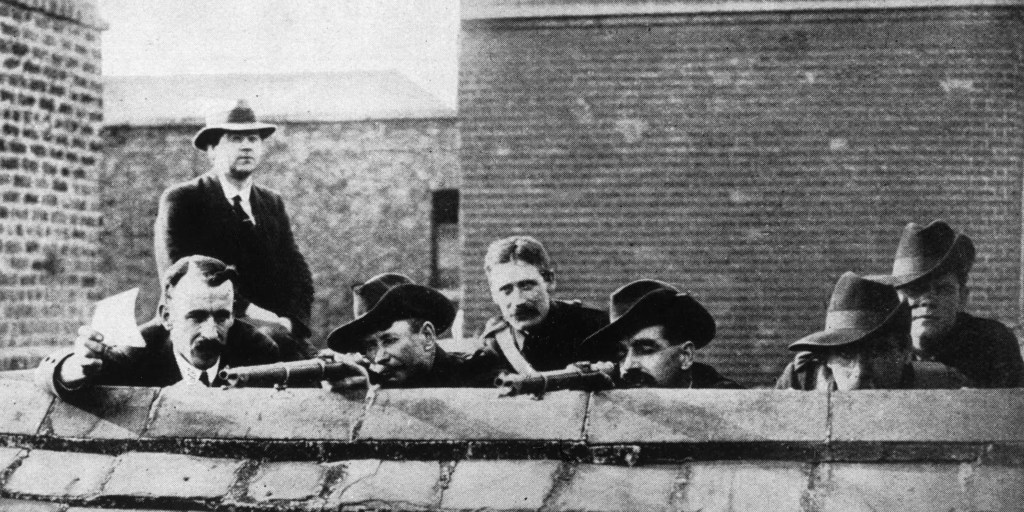
After a brief recap of the ‘Irish Question’ from 1801 – 1916, he took us through events in Dublin during and after the Easter Rising planned by the Irish Republican Brotherhood.  Using street maps of the city he retraced the events day by day but incorporated the number of Irish soldiers who were dying on the battlefields of the Western Front on the same days. He examined the motivation for the thousands of Irishmen who joined the British Army in 1914, when there was no conscription and Home Rule was enough for the majority of the population. The hostile attitudes of Dubliners to the defeated rebels after the Easter Rising are well known but Richard’s research had uncovered specifically how many men from the streets the rebels were led through were serving as volunteers in the British Army.  The mishandling of the defeated rebellion by the British showed how radicalised the civilian population had become by 1918.  The political landscape had completely changed and Home Rule was now not enough.

Cork’s particular place in the story was next illustrated by the role of four men from Cork; Michael Collins, Terence MacSwiney, Tomas MacCurtain and Thomas Kent who respectively took part in the Dublin Rising, died on Hunger Strike, was shot by the police and executed by the British.  Cork was regarded as the most violent county in the War of Independence.  It already had radical Gaelic and Republican groups before WW1. Its local MP DD Sheehan who had joined the British Army along with his sons was no longer welcome in Cork by 1918. His Home Rule stance was out of date.  Richard’s detailed research showed the mortality figures for the FWW compared with the internal struggle.  The myth often advanced is that more Irish killed each other in the Civil War but the figures showed a different story. 4,347 died in the FWW; 531 in the War of Independence against the British ; 53 during the Truce; 220 in the Civil War. Richard’s lecture was a mixture of myth busting, detailed data and some fascinating personalities like Emmet Dalton who fought on the Western Front with Tom Kettle. Emmet was with Michael Collins when he was assassinated.  Dalton later commented on the apparent contradiction of fighting both with and against the British Army by saying that he had fought for Ireland with the British and fought for Ireland against them.

All were energetic young men who were looking for adventure.

Our lecture had another good audience of 60 including twenty guests and four sixth form students.  Our question and answer session had at least ten questions and we could easily have gone on well past 9pm. 

Review of A level Tudor History Conference 25th March 2026                                                         

Our annual free conference for teachers and students was held in the University of Bristol Humanities Building.  Our speakers were Professor Ronald Hutton of Bristol University, Dr Tracy Borman Chief Historian of Historic Royal Palaces and Dr Sean Cunningham Head of Medieval Records at the National Archives.  This conference followed on from our conferences on Modern Russian History in 2024 and African Kingdoms in 2025.  This year’s topic is one of the most popular at A level and eleven sixth forms brought their students. Our speakers were distinguished historians who each brought their individual style to their lectures.

Professor Hutton explored why none of the Tudor Rebellions had succeeded and what this told us about why they happened; the motives of rebels and how Tudor government functioned.  This key topic at A level was explored with Professor Hutton’s characteristic wit and precision and brought the topic bang up to date.  Dr Borman gave her lecture via Zoom and presented the key men who had been role models, advisors, friends, and potential enemies to Henry VIII.  The students learnt much of Henry’s personality and as well as the familiar figures of Wolsey and Cromwell. Others emerged including Will Somers his official ‘fool,’ Charles Brandon brother-in-law and his closest friend and Sir Francis Bryan who lost one eye in a jousting match.  This rich cast of characters showed how Henry’s character developed and brought his reign to life. Using Zoom Tracy tackled some interesting questions including the one about a resemblance to the current American President.    

Finally, Dr Sean Cunningham tackled the reign of Henry VII the founder of the Tudor Dynasty.  The insecurity of Henry’s claim to the throne, the short time he had lived in England before he claimed the throne and his French accent established the challenge that faced Henry VII.  The steps that Henry VII took to establish his monarchy and how his reign ended in isolation and unpopularity were illustrated with rare documents from the archives which Sean curates and which have formed the basis of his new book Henry VII: Treason and Trust.

Each lecture was followed by well informed and lively questions from students and their teachers. We are already planning our 2027 Conference.

“Politics is something outside everyday life”: Understanding democratic engagement in twentieth-century Britain Professor Adrian Bingham University of Sheffield

Wednesday 18th March 2026

Adrian Bingham posed 4 key questions to introduce his lecture about the attitudes to politics of ordinary voters really new?

  • The historically low turnouts of 2001 and 2005?
  • The cynicism about politicians due to the expenses scandal of 2009?
  • 2010s-20s: rise in populism and anti-politics
  • How do we uncover how ordinary people (not activists) felt about politics in twentieth century Britian

He began by looking Arnold Freeman’s study of new voters of Sheffield in 1919 which examined the attitudes of 408 male and 408 female manual workers to see if they were ‘equipped to vote’. Freeman concluded the vast majority were not.  Professor Bingham’s research unpicked Freeman’s findings to examine how the voices of these voters had been mis-interrupted or taken out of context.  Women’s lives in particular with their dual burden of working both outside the home and inside had not even been considered when looking at why they were not able to engage with politics.     

The findings of social scientists and pollsters of 20th century Britain from Mass Observation onwards were examined.  While some academics saw disengagement by the electorate others argued that when politics was framed in concrete and personal terms the voters were engaged. Often politicians were not listening to voters as in 1945 when housing was the key issue with voters but not with any political party.  Political scientists continued to present out of date gender stereotypes of women being disengaged and more conservative than men.  The reasons for women’s disengagement were ignored. The male domination of Westminster politics up to the end of the twentieth century was clearly a shock to some of the students in the audience. The issues around the failure to reach young voters shown by how the turnout patterns have significantly widened was also explored. In terms of racial minorities Professor Bingham saw a shifting of ground from the attitudes of mainstream politicians towards Enoch Powell in the 1960s and those advancing populist right wing policies today. 

Some very relevant and thought provoking conclusions were presented.  Voters were now consumers and more well informed than a century ago.  Our political institutions have not adapted to a world of heightened consumer expectation, social and cultural diversity, and personal choice.  The political loyalty that was based on our strong class system and worked well in our first past the post system was now in trouble.  Naturally given the present political changes with the rise of Reform and the Greens and recent by-election results there were many lively questions from our audience. 

A successful meeting with an audience of 59. Our next meeting on the Easter Rising in April 1916 should be equally fascinating.

Multiracial Britishness in Hong Kong, 1910-1945   

Dr Vivian Kong, University of Bristol 

Wednesday 11th February 2026

Dr Kong began her lecture by setting the context of the British colony (1841-1997). She Illustrated the rosy and nostalgic view of Britishness and British rule that some Hong Kongers now have of British rule. She showed long queues to sign the official condolence book after Queen Elizabeth’s death and the letter sent by school students in 2019 to ask for help during the anti-government protest crisis. The letter was full of references to British history including ‘our darkest hour.’ These modern events fly in the face of the unfairness of historic British colonialism. Her research and recent book have explored the reality of what it meant to identify as British in Hong Kong in the period from 1910-45. The multiracial society of Hong Kong included varieties of Chinese peoples, the White British, Eurasian mixed race, the local Portuguese and Macanese and many other racial groups. Dr Kong had used a range of sources including the archives of her own university )Hong Kong University) and oral history research which took her to Australia and California.
Dr Kong explored the different ways in which people identified as British. This included the legal right to a British passport and service in the Armed forces. The Kew archives had uncovered how the British Government had tried to restrict access to full British passports but increasingly by the 1920s some Hong Kongers knew their rights and were able to travel to the UK. The aim of opening a university in Hong Kong was also examined as a way for the British to influence mainland China by educating subsidised Chinese students alongside more Westernised Hong Kong and overseas Asia students. When Chinese Nationalist protests happened in Hong Kong in 1925 against British colonialism students were careful to stay separate from it despite their admiration for their own culture they did not want to forgo their scholarships.
Another aspect of British rule was the censorship of the Press and the treatment of the local Portuguese and Macanese mixed race communities. These groups engaged with Britishness, sending their children to Catholic English speaking schools. In these schools children sang the British National Anthem, joined the Scouts, and took part in Empire Day. As adults these communities more often spoke English than patois or Portuguese and took part in military service. A typical member of this community was Dr Eddie Gesano a mixed race Macanese doctor. He noted the discrimination he experienced as doctor who was paid only 25% of an Irish anaesthetist in the same hospital. Despite this discrimination there were attempts to build bridges between the communities and it was seen as a protection against Chinese Nationalism. In many ways they were protecting their class and economic interests.
Dr Kong showed how the Macanese and Portuguese communities despite their service in 2nd World War were not recognised as British citizens and as a result many left to go to other English speaking parts of the world including California in the USA, Canada, and Australia (where she interviewed some of them). Many of the issues raised in the lecture are still highly relevant not just to modern day Hong Kong and its relationship with Communist China but to multiracial Britain and how different communities identify with the dominant nationality. The lecture was followed with some excellent questions, including several from members who had visited or worked in Hong Kong before 1997.

PUB QUIZ. A very competitive contest.

Ten teams competed for the much coveted Bristol Historical Association trophy at the Eldon House. Last year’s champions ‘Last Man Thinking’ took second place alongside ‘Quizteam Counsell’ with 59 points a piece.

The ‘Wobbley Walkers‘ walked away with the trophy with 66 points. The ‘Tyros’ came a close fourth with 58 and a half points.

Thank you to all our contestants. It is fair to say that the questions were more challenging this year. A big thanks to our hosts at the Eldon House. We shall be back next year.

What you remember is your own, what you sketch you steal – CHA Voysey – a lecture by Professor Ian Hamerton 21st January 2026

Professor Ian Hamerton shared his enthusiasm and expertise on the Arts and Craft Architect and Designer Charles Frances Annesley Voysey with the Bristol Branch last Wednesday. Voysey’s father and large family had a key impact on Voysey.  He was descended from the Wesleys. The massive scandal around his father (who lost his living as a curate for his beliefs on eternal damnation) led Voysey down an unusual path.  His training as an architect with three different architects created a gifted young architect who had built an extensive practice by the 1890s.  Professor Hamerton outlined the distinctive aspects of the Voysey house using Voysey’s original design drawings.  The early sketches showed half-timbering and vernacular designs not unlike those of contemporaries like Renee Mackintosh but over time a very distinctive Voysey style emerged. 

In all 117 Voysey houses exist, although many other builders copied his style. Professor Hamerton  literally took us through one of the most successful Voysey houses, Moor Crag in Gillhead near Windermere.  Features like the broad welcoming front door, the circular windows, the low catslide roof, the broad chimneys and the asymmetrical design were not just illustrated but explained in terms of Voysey’s own beliefs on architecture.  Voysey’s brilliant collaboration with builders and artisans (like Thomas Elsley) meant the houses included motifs like the heart shape that linked to the religious ideas of the Voysey family. Almost no detail was too small for Voysey the designer.  Voysey’s designs of some offices have survived better than the insides of his houses including the Essex and Suffolk Equitable Insurance Company Office.  Voysey sadly had less work after the First World War as an architect of houses but his work as a textile, wallpaper  and clock designer and even a designer of his own clothes showed his versatility and surprising playfulness.  Many of us in the audience were inspired on a very wet Wednesday evening to plan visits to the Voysey houses that exist in England over the coming months.