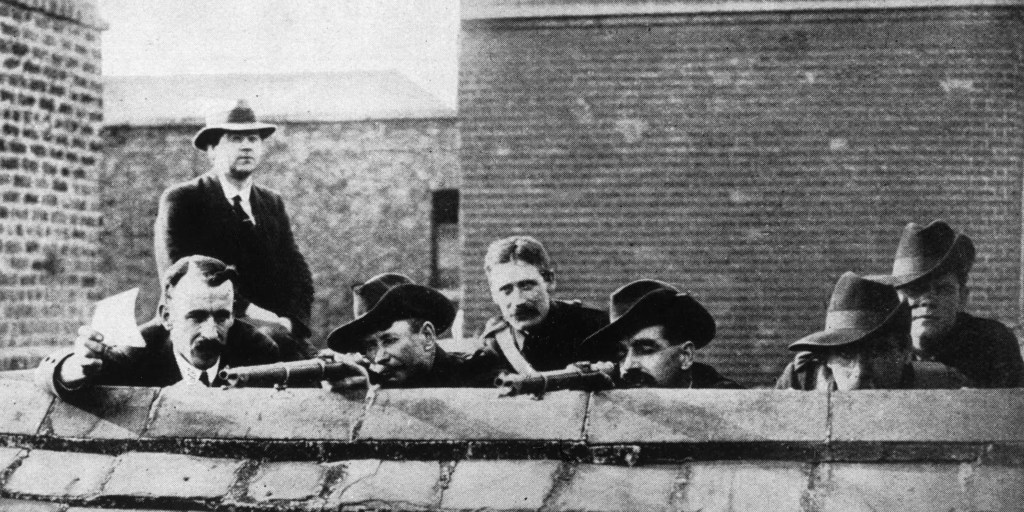
Professor R Grayson Oxford Brookes University
29th April 2026
Our eighth lecture this year was given by Professor Richard Grayson. His aim was show how two stories, the First World War and the Easter Rising usually given separate treatment affected each other. His military history was not about specific battles and tactics but ‘military history from the streets’. He began with his own family involvement. His grandmother Maud whose husband and three close relatives fought in the war. His work on Belfast, the Easter Rising of 1916 and his most recent research on the Irish Revolution in Cork formed the background to the lecture.
After a brief recap of the ‘Irish Question’ from 1801 – 1916, he took us through events in Dublin during and after the Easter Rising planned by the Irish Republican Brotherhood. Using street maps of the city he retraced the events day by day but incorporated the number of Irish soldiers who were dying on the battlefields of the Western Front on the same days. He examined the motivation for the thousands of Irishmen who joined the British Army in 1914, when there was no conscription and Home Rule was enough for the majority of the population. The hostile attitudes of Dubliners to the defeated rebels after the Easter Rising are well known but Richard’s research had uncovered specifically how many men from the streets the rebels were led through were serving as volunteers in the British Army. The mishandling of the defeated rebellion by the British showed how radicalised the civilian population had become by 1918. The political landscape had completely changed and Home Rule was now not enough.
Cork’s particular place in the story was next illustrated by the role of four men from Cork; Michael Collins, Terence MacSwiney, Tomas MacCurtain and Thomas Kent who respectively took part in the Dublin Rising, died on Hunger Strike, was shot by the police and executed by the British. Cork was regarded as the most violent county in the War of Independence. It already had radical Gaelic and Republican groups before WW1. Its local MP DD Sheehan who had joined the British Army along with his sons was no longer welcome in Cork by 1918. His Home Rule stance was out of date. Richard’s detailed research showed the mortality figures for the FWW compared with the internal struggle. The myth often advanced is that more Irish killed each other in the Civil War but the figures showed a different story. 4,347 died in the FWW; 531 in the War of Independence against the British ; 53 during the Truce; 220 in the Civil War. Richard’s lecture was a mixture of myth busting, detailed data and some fascinating personalities like Emmet Dalton who fought on the Western Front with Tom Kettle. Emmet was with Michael Collins when he was assassinated. Dalton later commented on the apparent contradiction of fighting both with and against the British Army by saying that he had fought for Ireland with the British and fought for Ireland against them.
All were energetic young men who were looking for adventure.
Our lecture had another good audience of 60 including twenty guests and four sixth form students. Our question and answer session had at least ten questions and we could easily have gone on well past 9pm.