A huge thank you to Evan Jones for leading 23 of us around Millerd’s Bristol. We started on Bristol Bridge and finished on Brandon Hill. There was so much to see and hear that the walk took nearly three hours. It was well worth it. If you would like to follow our route go to the BRISTOL HISTORY RESOURCES section of our website where Evan has included a google map.
The Easter Rising in Dublin and Cork and its First World War Context
Professor R Grayson Oxford Brookes University
29th April 2026
Our eighth lecture this year was given by Professor Richard Grayson. His aim was show how two stories, the First World War and the Easter Rising usually given separate treatment affected each other. His military history was not about specific battles and tactics but ‘military history from the streets’. He began with his own family involvement. His grandmother Maud whose husband and three close relatives fought in the war. His work on Belfast, the Easter Rising of 1916 and his most recent research on the Irish Revolution in Cork formed the background to the lecture.
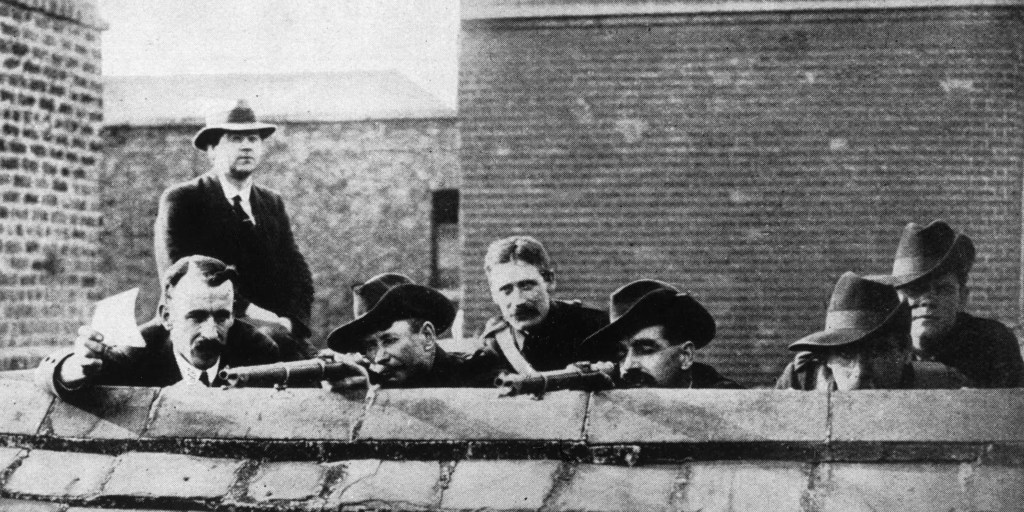
After a brief recap of the ‘Irish Question’ from 1801 – 1916, he took us through events in Dublin during and after the Easter Rising planned by the Irish Republican Brotherhood. Using street maps of the city he retraced the events day by day but incorporated the number of Irish soldiers who were dying on the battlefields of the Western Front on the same days. He examined the motivation for the thousands of Irishmen who joined the British Army in 1914, when there was no conscription and Home Rule was enough for the majority of the population. The hostile attitudes of Dubliners to the defeated rebels after the Easter Rising are well known but Richard’s research had uncovered specifically how many men from the streets the rebels were led through were serving as volunteers in the British Army. The mishandling of the defeated rebellion by the British showed how radicalised the civilian population had become by 1918. The political landscape had completely changed and Home Rule was now not enough.
Cork’s particular place in the story was next illustrated by the role of four men from Cork; Michael Collins, Terence MacSwiney, Tomas MacCurtain and Thomas Kent who respectively took part in the Dublin Rising, died on Hunger Strike, was shot by the police and executed by the British. Cork was regarded as the most violent county in the War of Independence. It already had radical Gaelic and Republican groups before WW1. Its local MP DD Sheehan who had joined the British Army along with his sons was no longer welcome in Cork by 1918. His Home Rule stance was out of date. Richard’s detailed research showed the mortality figures for the FWW compared with the internal struggle. The myth often advanced is that more Irish killed each other in the Civil War but the figures showed a different story. 4,347 died in the FWW; 531 in the War of Independence against the British ; 53 during the Truce; 220 in the Civil War. Richard’s lecture was a mixture of myth busting, detailed data and some fascinating personalities like Emmet Dalton who fought on the Western Front with Tom Kettle. Emmet was with Michael Collins when he was assassinated. Dalton later commented on the apparent contradiction of fighting both with and against the British Army by saying that he had fought for Ireland with the British and fought for Ireland against them.
All were energetic young men who were looking for adventure.
Our lecture had another good audience of 60 including twenty guests and four sixth form students. Our question and answer session had at least ten questions and we could easily have gone on well past 9pm.

Review of A level Tudor History Conference 25th March 2026
Our annual free conference for teachers and students was held in the University of Bristol Humanities Building. Our speakers were Professor Ronald Hutton of Bristol University, Dr Tracy Borman Chief Historian of Historic Royal Palaces and Dr Sean Cunningham Head of Medieval Records at the National Archives. This conference followed on from our conferences on Modern Russian History in 2024 and African Kingdoms in 2025. This year’s topic is one of the most popular at A level and eleven sixth forms brought their students. Our speakers were distinguished historians who each brought their individual style to their lectures.
Professor Hutton explored why none of the Tudor Rebellions had succeeded and what this told us about why they happened; the motives of rebels and how Tudor government functioned. This key topic at A level was explored with Professor Hutton’s characteristic wit and precision and brought the topic bang up to date. Dr Borman gave her lecture via Zoom and presented the key men who had been role models, advisors, friends, and potential enemies to Henry VIII. The students learnt much of Henry’s personality and as well as the familiar figures of Wolsey and Cromwell. Others emerged including Will Somers his official ‘fool,’ Charles Brandon brother-in-law and his closest friend and Sir Francis Bryan who lost one eye in a jousting match. This rich cast of characters showed how Henry’s character developed and brought his reign to life. Using Zoom Tracy tackled some interesting questions including the one about a resemblance to the current American President.
Finally, Dr Sean Cunningham tackled the reign of Henry VII the founder of the Tudor Dynasty. The insecurity of Henry’s claim to the throne, the short time he had lived in England before he claimed the throne and his French accent established the challenge that faced Henry VII. The steps that Henry VII took to establish his monarchy and how his reign ended in isolation and unpopularity were illustrated with rare documents from the archives which Sean curates and which have formed the basis of his new book Henry VII: Treason and Trust.
Each lecture was followed by well informed and lively questions from students and their teachers. We are already planning our 2027 Conference.

“Politics is something outside everyday life”: Understanding democratic engagement in twentieth-century Britain Professor Adrian Bingham University of Sheffield
Wednesday 18th March 2026

Adrian Bingham posed 4 key questions to introduce his lecture about the attitudes to politics of ordinary voters really new?
- The historically low turnouts of 2001 and 2005?
- The cynicism about politicians due to the expenses scandal of 2009?
- 2010s-20s: rise in populism and anti-politics
- How do we uncover how ordinary people (not activists) felt about politics in twentieth century Britian
He began by looking Arnold Freeman’s study of new voters of Sheffield in 1919 which examined the attitudes of 408 male and 408 female manual workers to see if they were ‘equipped to vote’. Freeman concluded the vast majority were not. Professor Bingham’s research unpicked Freeman’s findings to examine how the voices of these voters had been mis-interrupted or taken out of context. Women’s lives in particular with their dual burden of working both outside the home and inside had not even been considered when looking at why they were not able to engage with politics.

The findings of social scientists and pollsters of 20th century Britain from Mass Observation onwards were examined. While some academics saw disengagement by the electorate others argued that when politics was framed in concrete and personal terms the voters were engaged. Often politicians were not listening to voters as in 1945 when housing was the key issue with voters but not with any political party. Political scientists continued to present out of date gender stereotypes of women being disengaged and more conservative than men. The reasons for women’s disengagement were ignored. The male domination of Westminster politics up to the end of the twentieth century was clearly a shock to some of the students in the audience. The issues around the failure to reach young voters shown by how the turnout patterns have significantly widened was also explored. In terms of racial minorities Professor Bingham saw a shifting of ground from the attitudes of mainstream politicians towards Enoch Powell in the 1960s and those advancing populist right wing policies today.

Some very relevant and thought provoking conclusions were presented. Voters were now consumers and more well informed than a century ago. Our political institutions have not adapted to a world of heightened consumer expectation, social and cultural diversity, and personal choice. The political loyalty that was based on our strong class system and worked well in our first past the post system was now in trouble. Naturally given the present political changes with the rise of Reform and the Greens and recent by-election results there were many lively questions from our audience.
A successful meeting with an audience of 59. Our next meeting on the Easter Rising in April 1916 should be equally fascinating.
Multiracial Britishness in Hong Kong, 1910-1945
Dr Vivian Kong, University of Bristol
Wednesday 11th February 2026
Dr Kong began her lecture by setting the context of the British colony (1841-1997). She Illustrated the rosy and nostalgic view of Britishness and British rule that some Hong Kongers now have of British rule. She showed long queues to sign the official condolence book after Queen Elizabeth’s death and the letter sent by school students in 2019 to ask for help during the anti-government protest crisis. The letter was full of references to British history including ‘our darkest hour.’ These modern events fly in the face of the unfairness of historic British colonialism. Her research and recent book have explored the reality of what it meant to identify as British in Hong Kong in the period from 1910-45. The multiracial society of Hong Kong included varieties of Chinese peoples, the White British, Eurasian mixed race, the local Portuguese and Macanese and many other racial groups. Dr Kong had used a range of sources including the archives of her own university )Hong Kong University) and oral history research which took her to Australia and California.
Dr Kong explored the different ways in which people identified as British. This included the legal right to a British passport and service in the Armed forces. The Kew archives had uncovered how the British Government had tried to restrict access to full British passports but increasingly by the 1920s some Hong Kongers knew their rights and were able to travel to the UK. The aim of opening a university in Hong Kong was also examined as a way for the British to influence mainland China by educating subsidised Chinese students alongside more Westernised Hong Kong and overseas Asia students. When Chinese Nationalist protests happened in Hong Kong in 1925 against British colonialism students were careful to stay separate from it despite their admiration for their own culture they did not want to forgo their scholarships.
Another aspect of British rule was the censorship of the Press and the treatment of the local Portuguese and Macanese mixed race communities. These groups engaged with Britishness, sending their children to Catholic English speaking schools. In these schools children sang the British National Anthem, joined the Scouts, and took part in Empire Day. As adults these communities more often spoke English than patois or Portuguese and took part in military service. A typical member of this community was Dr Eddie Gesano a mixed race Macanese doctor. He noted the discrimination he experienced as doctor who was paid only 25% of an Irish anaesthetist in the same hospital. Despite this discrimination there were attempts to build bridges between the communities and it was seen as a protection against Chinese Nationalism. In many ways they were protecting their class and economic interests.
Dr Kong showed how the Macanese and Portuguese communities despite their service in 2nd World War were not recognised as British citizens and as a result many left to go to other English speaking parts of the world including California in the USA, Canada, and Australia (where she interviewed some of them). Many of the issues raised in the lecture are still highly relevant not just to modern day Hong Kong and its relationship with Communist China but to multiracial Britain and how different communities identify with the dominant nationality. The lecture was followed with some excellent questions, including several from members who had visited or worked in Hong Kong before 1997.

PUB QUIZ. A very competitive contest.
Ten teams competed for the much coveted Bristol Historical Association trophy at the Eldon House. Last year’s champions ‘Last Man Thinking’ took second place alongside ‘Quizteam Counsell’ with 59 points a piece.
The ‘Wobbley Walkers‘ walked away with the trophy with 66 points. The ‘Tyros’ came a close fourth with 58 and a half points.
Thank you to all our contestants. It is fair to say that the questions were more challenging this year. A big thanks to our hosts at the Eldon House. We shall be back next year.

What you remember is your own, what you sketch you steal – CHA Voysey – a lecture by Professor Ian Hamerton 21st January 2026
Professor Ian Hamerton shared his enthusiasm and expertise on the Arts and Craft Architect and Designer Charles Frances Annesley Voysey with the Bristol Branch last Wednesday. Voysey’s father and large family had a key impact on Voysey. He was descended from the Wesleys. The massive scandal around his father (who lost his living as a curate for his beliefs on eternal damnation) led Voysey down an unusual path. His training as an architect with three different architects created a gifted young architect who had built an extensive practice by the 1890s. Professor Hamerton outlined the distinctive aspects of the Voysey house using Voysey’s original design drawings. The early sketches showed half-timbering and vernacular designs not unlike those of contemporaries like Renee Mackintosh but over time a very distinctive Voysey style emerged.
In all 117 Voysey houses exist, although many other builders copied his style. Professor Hamerton literally took us through one of the most successful Voysey houses, Moor Crag in Gillhead near Windermere. Features like the broad welcoming front door, the circular windows, the low catslide roof, the broad chimneys and the asymmetrical design were not just illustrated but explained in terms of Voysey’s own beliefs on architecture. Voysey’s brilliant collaboration with builders and artisans (like Thomas Elsley) meant the houses included motifs like the heart shape that linked to the religious ideas of the Voysey family. Almost no detail was too small for Voysey the designer. Voysey’s designs of some offices have survived better than the insides of his houses including the Essex and Suffolk Equitable Insurance Company Office. Voysey sadly had less work after the First World War as an architect of houses but his work as a textile, wallpaper and clock designer and even a designer of his own clothes showed his versatility and surprising playfulness. Many of us in the audience were inspired on a very wet Wednesday evening to plan visits to the Voysey houses that exist in England over the coming months.
Review of Andrew Foyle’s Lecture on Bristol’s Distinctive Buildings 3rd December 2025
After our Christmas drinks and mince pies a large gathering (98 people) of the Bristol Branch of the Historical Association had a great end to a very successful term of lectures. Andrew Foyle is the author of two volumes of the Pevsner Guide covering the City of Bristol and North Somerset. He is an acknowledged expert on the architecture of the city and has worked on the renovation of many of the city’s distinctive buildings. He presented his personal choices grouping together the Lodge Houses, like Red Lodge, and the timber framed houses many of which still survived. He covered the middling sized Bristol country houses like Stoke House (Stoke Bishop), Langton Court (Brislington), Oldbury Court (Fishponds), Henbury Great House and Old Sneed Park. Many of them were ‘old fashioned’ compared with houses built in London or other parts of England. However, Kings Weston House was a one off. It was built by Sir John Vanbrugh the architect of Castle Howard and Blenheim Palace.
Andrew then moved back into the city to look at Town Houses such as Elton House (St James Barton) and Churches and Chapels. These included Christ Church with St Ewen on Broad Street where the Paty family brought their skills as architects and craftsmen and the contrasting chapels. The nonconformist chapels were often austere from the outside but some contained elegant interiors. Next the Gothick grottos of Goldney House and Crew’s Hole were explored and Black Castle and Arnos Court where the Paty influence was again on display.
A particular highlight of the lecture was the exploration of Clifton. Even the austere Pevsner had admitted ‘no-one can resist the charms of Clifton’s confusion.’ Andrew demonstrated that unlike the better known Bath, Clifton contained squares that weren’t square and homes not planned to a single unified design. Its mishmash of styles and the disaster of a bank crash in the 1790s had led to the scaling down of Windsor Terrace and the Royal York Crescent (reputed to be the longest crescent in Europe). The way that Bristol architecture responded to its landscape was breathtaking in Andrew’s slides.
Sadly, the clock was now ticking so Andrew dipped into his examples from the 19th and 20th century for two amazing buildings. The Granary on Welsh Back built by Ponton and Gough was described ‘as working machine’ for drying grain and finally the ‘Council House’, now City Hall. This building by Emmanuel Vincent Harris was begun in the 1930’s and finally opened in the 1956. Andrew demonstrated that in fact the delays to build a new town hall (originally proposed in the 1880s) had been going on for decades before and a range of sites had been considered before work finally began in 1936. He showed us the beautiful furniture and interior designs from the Council House, some of which had now been returned to their original locations due to a research project he worked on. He also corrected some of the convenient myths around the statue of Cabot and those gilded unicorns on the roof which had always been in the original design.
His conclusions rang true for many of us living in Bristol. Bristol’s unique character was insular, conservative and behind the curve of fashions. It was dominated by a few aristocratic families or estates. It was governed by a mercantile oligarchy of inter-dependant families. However it tended to inertia in decision making. It relied on home grown architects and builders. Its city and hinterland were full of piecemeal development and as result there tended to leave piecemeal survivors from previous eras. Although Bristol was industrialised there was no one dominant industry. Bristol has surviving pre-industrial elements including medieval churches and timber framed houses. A truly unique city.


The Bristol Sixth Form History Pizza Quiz
On 19th November the Bristol Branch of the HA ran its second Pizza Quiz for local Sixth Formers. As with our first event in June we had a large number of teams from local schools taking part. The format was very similar to a pub quiz but with free pizza instead of drinks and it again took place at Bristol University. Students from the PGCE course at Bristol acted as marshals for the quiz. Mary Feerick, Rob Pritchard (Secretary and Treasurer of the Bristol Branch) and David Rawlings from Bristol Education Department acted as quiz masters. The rounds were on popular topics at GCSE and A level plus some local History. Students had some forewarning about the topics so they could mug up their knowledge. Despite a freezing cold night, we had a great turnout of almost 60 students from 7 different sixth forms and it was both competitive and fun. Many teams played their Joker on the Tudors round. The winners were the Suigan Garrison from St Mary Redcliffe School with 62 points out of a possible 72. They were awarded Bristol HA cups.
Teachers got in touch to thank the Branch the next day “a huge thank you for the time taken to put on such an enjoyable Pizza Quiz. Students really enjoyed themselves and it was a lovely way to spend a Wednesday evening.” (Rebecca Griffiths, Gordano School) and “Thank you for organising and running the quiz. It was very successful and the BGS students thoroughly enjoyed it.” (Andy Jarvis, Bristol Grammar School)