
12th February 2025
Our February Bristol HA lecture was another very well attended event with 107 in the audience. It included 44 sixth formers from 5 sixth forms as well as many members and guests.
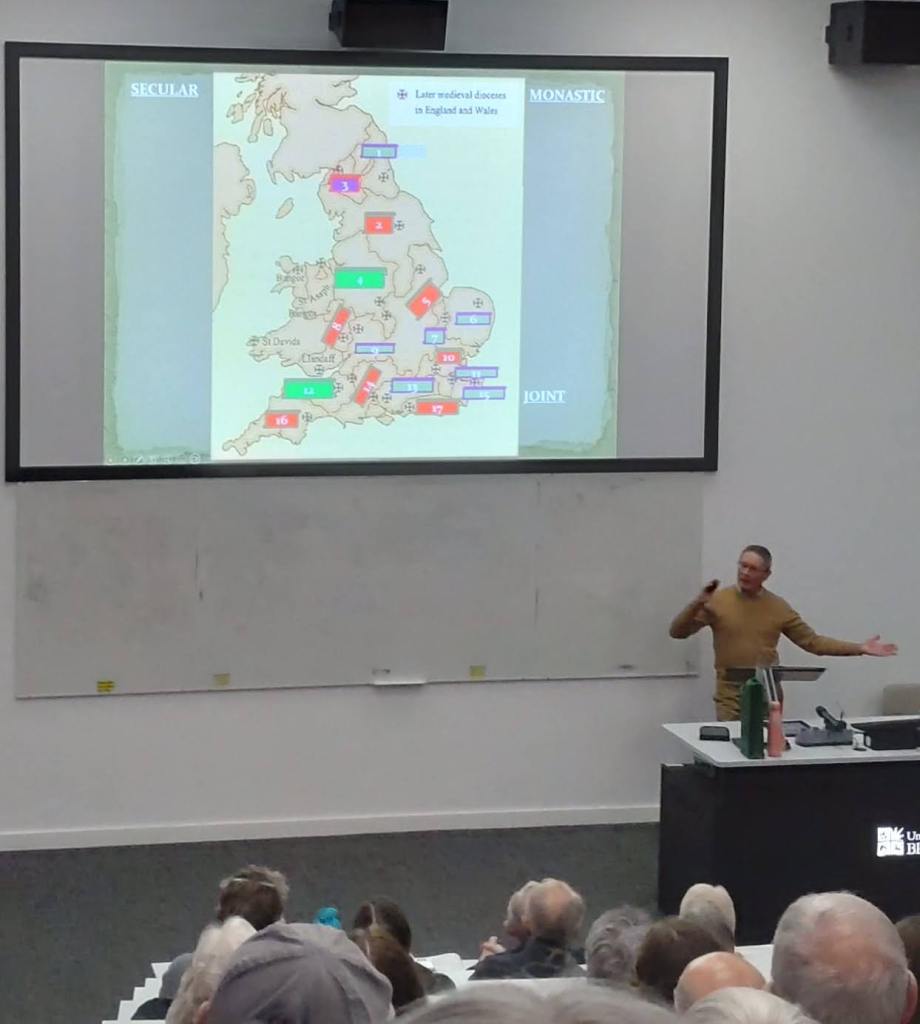
Dr Richard Fisher explained the context of how pre-reformation cathedrals were divided into monastic and secular types. Richard was able to clarify the differences between the deans, canons, priors, vicars and so on. He involved the audience by using a map to show where English cathedrals were sited. His research focused on how the Three Choirs Cathedrals (Hereford, Worcester and Gloucester) only 25 miles apart, differed in how they related to their communities. He had examined maps to show how the cathedrals were sited and how the structures of the cathedrals reflected relationships with their communities. Hereford was very much the parish Cathedral with easy public access and also a community where Catholic sympathies lasted much longer. Mary’s restoration was easily achieved as little had changed in the building during Edward’s reign and in Elizabeth’s early reign it was described as full of ‘rank papists.’ Gloucester’s famous Cathedral on the other hand had very little contact with the people of Gloucester and was a ‘gated community’. Archives showed that the community at Gloucester left very little to these great buildings preferring to leave money to their parish churches. Richard showed how Gloucester Cathedral was divided between the older public nave at the west end and the far richer perpendicular east end with its choir, presbytery and lady chapel. Worcester Cathedral by contrast had good relations with the people of Worcester and its symmetrical layout between its Nave and ‘retro-choir’ showed the Laity had a real stake in the Cathedral.
Richard then moved on to the creation of Bristol Cathedral which began as a Norman abbey. It was not a corrupt abbey in the 16th century but not a popular one either. Again, Bristol’s citizens chose to invest in their parish churches more than the Abbey. In fact, there had been disputes between the people of Bristol and St Augustine’s Abbey for centuries. The abbey was briefly closed from 1540-41 but a new Cathedral was created in 1542, and it was refounded by Mary in 1554. After the Reformation the partially built west end of Bristol Cathedral was taken down leaving a truncated cathedral. The west end was not rebuilt until the 1860s. Bristol’s Cathedral was not one of the ‘plum’ Church of England dioceses with far less clergy than its Three Choirs neighbours.
There were many well-informed questions from our audience who appreciated how much they had leaned about the cathedrals of our region.
 Bristol Historical Association