
September 24th 2025
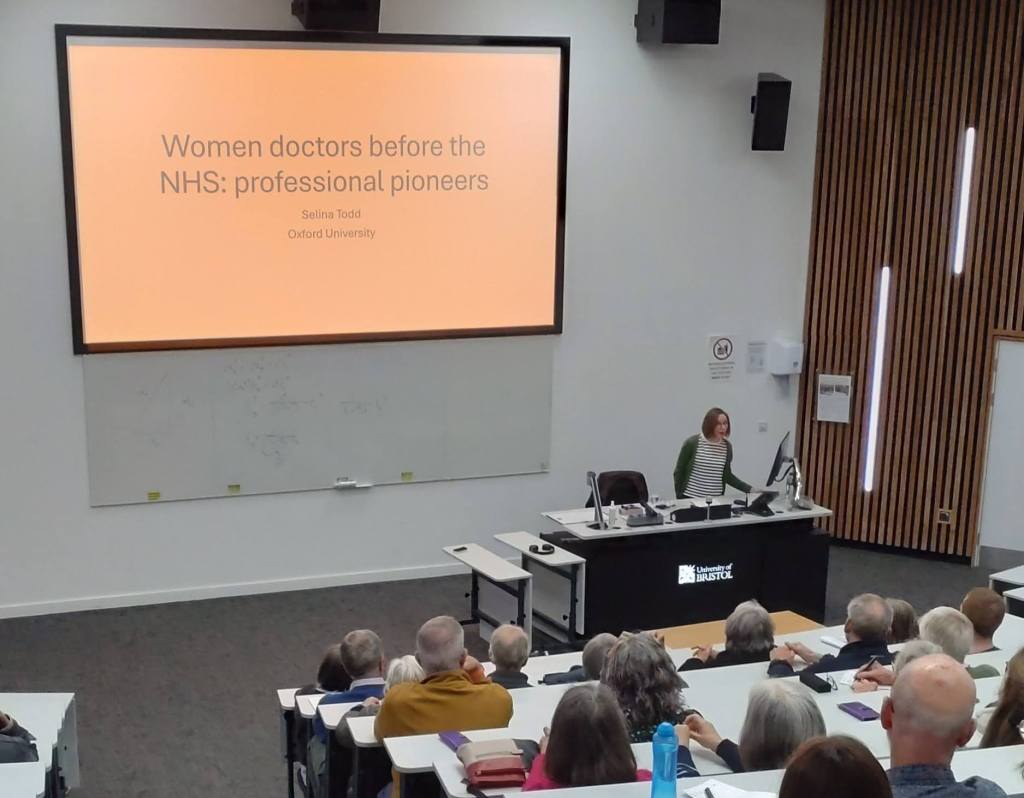
Our first lecture of the 2025-26 season got off to a great start with Professor Selina Todd of Oxford University sharing her fascinating research of the generation of women doctors who went into the medical profession after the initial breakthrough. This second cohort of women numbered just over 600 by the First World War. Her lecture concentrated on the careers of three doctors Ethel Williams, 1863-1948, Grace Stewart Billings, 1872-1957 and Marion Gilchrist, 1864-1952. She explained the sources she used including census returns and the digitized library of the Wellcome Institute and how she was still looking for more personal papers of individual doctors. These early doctors were often supported by their sympathetic families including fathers and husbands. Scotland seems to have produced a disproportionate number of women doctors.
Professor Todd illustrated the barriers put in these qualified doctors’ path by the medical establishment. It was very hard for them to obtain clinical experience which meant that many went into general practice or public health. A question posed was were these early women doctors going into these areas because they would be accepted, they were lower paid and there was no established career ladder? Whatever the answer there was clearly a link between these areas and the foundation of the post-war NHS. The other barriers they faced included being blocked from senior posts and the bars placed in front of married women in institutions like hospitals. The talk ranged outside the areas of discrimination in the profession to wider issues such as how they coped as women doctors. In some rural areas women doctors were the first people to buy cars. There were links to the women’s suffrage movement, particularly the 1911 census protest. Other questions asked were ‘Who they lived with?’ ‘How many of them got married and to who?’ ‘Their role in the First World War’ and the backlash they faced as men returned to the profession after 1918. Finally, Professor Todd has investigated their relationship with the medical profession after they retired including Ethel Williams support for the next generation of women doctors and care for refugees and evacuees. The lecture stressed that historians needed to investigate the whole lives of pioneers not just their struggles. The audience asked some fascinating questions. Walford Gillison shared the experience of his grandmother who had to go Scotland after her training in London to be awarded her medical degree. Another member of the audience asked about the records female doctors had written after the Great War about their contribution to the war effort which was done so that they would not be written out of history.
71 people attended the lecture.
 Bristol Historical Association