Review of Andrew Foyle’s Lecture on Bristol’s Distinctive Buildings    3rd December 2025

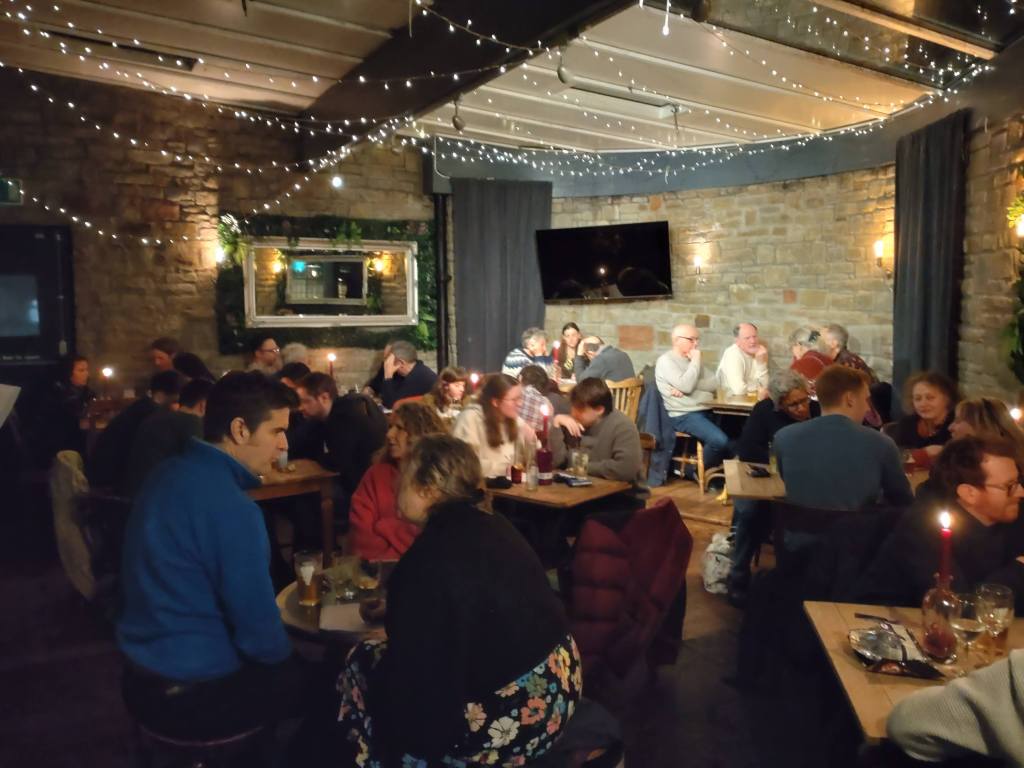
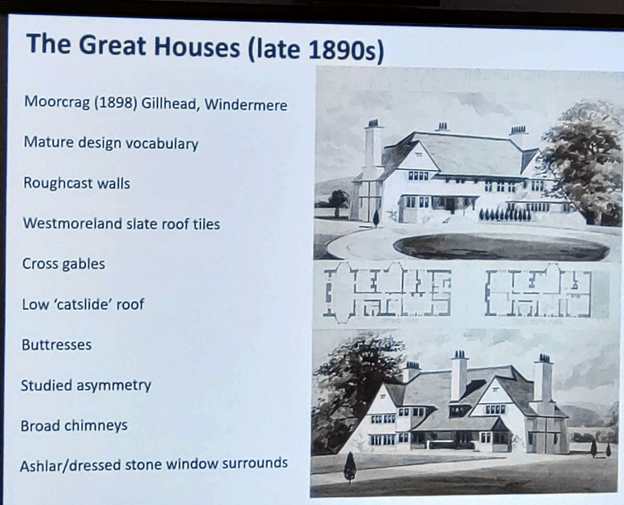
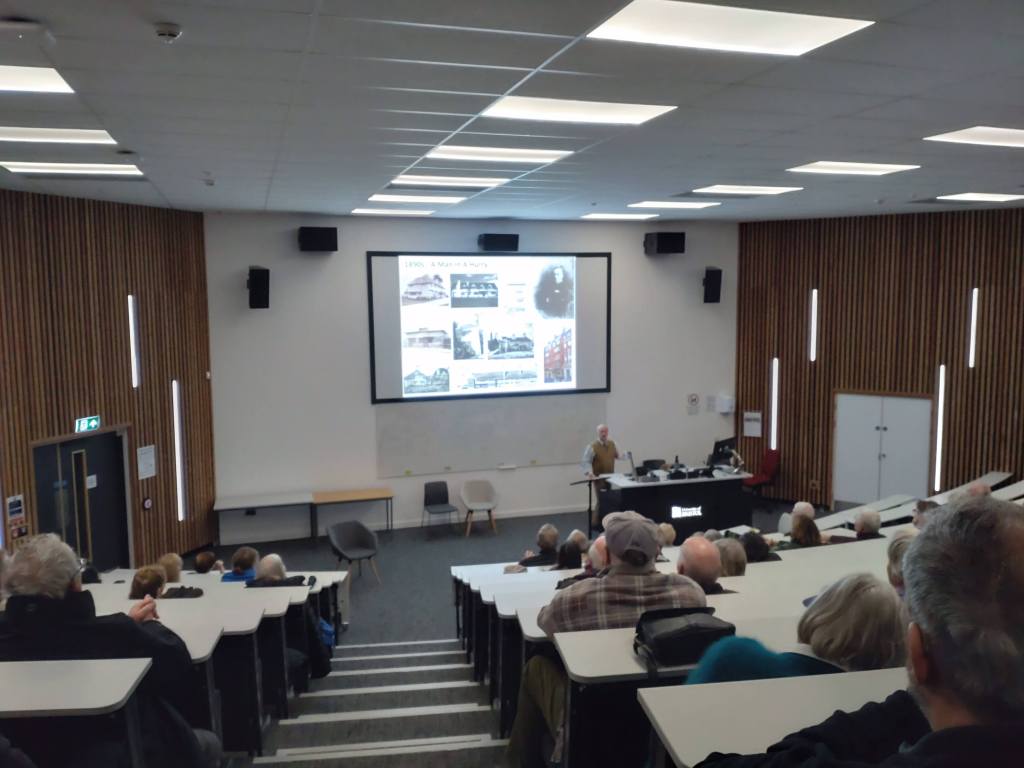
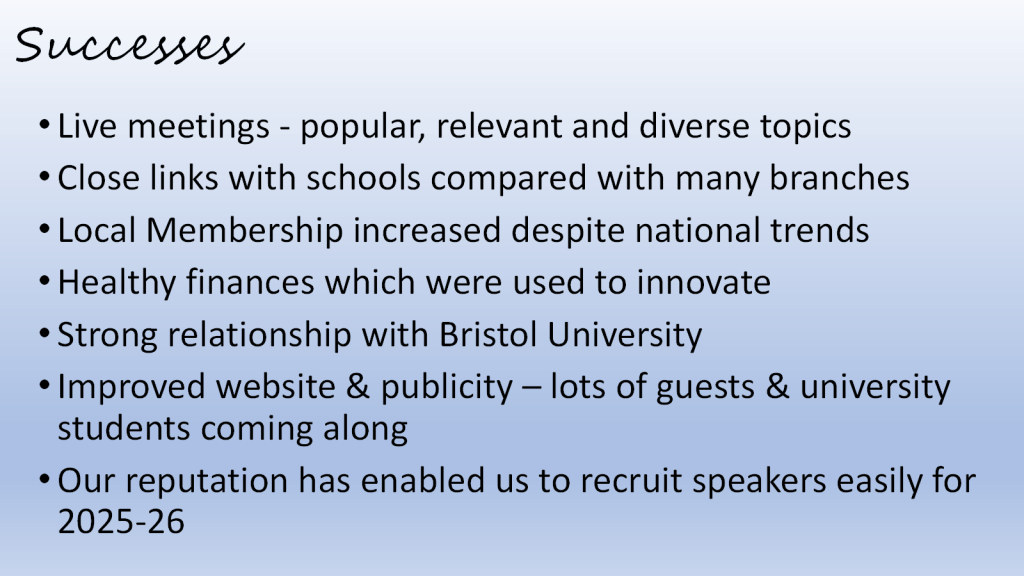
After our Christmas drinks and mince pies a large gathering (98 people) of the Bristol Branch of the Historical Association had a great end to a very successful term of lectures.  Andrew Foyle is the author of two volumes of the Pevsner Guide covering the City of Bristol and North Somerset. He is an acknowledged expert on the architecture of the city and has worked on the renovation of many of the city’s distinctive buildings.  He presented his personal choices grouping together the Lodge Houses, like Red Lodge, and the timber framed houses many of which still survived.   He covered the middling sized Bristol country houses like Stoke House (Stoke Bishop), Langton Court (Brislington), Oldbury Court (Fishponds), Henbury Great House and Old Sneed Park. Many of them were ‘old fashioned’ compared with houses built in London or other parts of England.  However, Kings Weston House was a one off.  It was built by Sir John Vanbrugh the architect of Castle Howard and Blenheim Palace.   

Andrew then moved back into the city to look at Town Houses such as Elton House (St James Barton) and Churches and Chapels. These included Christ Church with St Ewen on Broad Street where the Paty family brought their skills as architects and craftsmen and the contrasting chapels.  The nonconformist chapels were often austere from the outside but some contained elegant interiors.  Next the Gothick grottos of Goldney House and Crew’s Hole were explored and Black Castle and Arnos Court where the Paty influence was again on display.

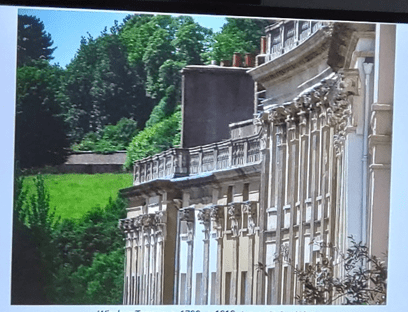
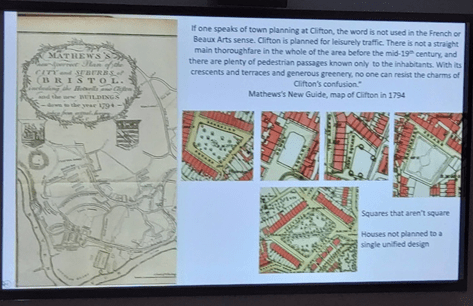
A particular highlight of the lecture was the exploration of Clifton.  Even the austere Pevsner had admitted ‘no-one can resist the charms of Clifton’s confusion.’ Andrew demonstrated that unlike the better known Bath, Clifton contained squares that weren’t square and homes not planned to a single unified design.  Its mishmash of styles and the disaster of a bank crash in the 1790s had led to the scaling down of Windsor Terrace and the Royal York Crescent (reputed to be the longest crescent in Europe).  The way that Bristol architecture responded to its landscape was breathtaking in Andrew’s slides. 

Sadly, the clock was now ticking so Andrew dipped into his examples from the 19th and 20th century for two amazing buildings.  The Granary on Welsh Back built by Ponton and Gough was described ‘as working machine’ for drying grain and finally the ‘Council House’, now City Hall.  This building by Emmanuel Vincent Harris was begun in the 1930’s and finally opened in the 1956. Andrew demonstrated that in fact the delays to build a new town hall (originally proposed in the 1880s) had been going on for decades before and a range of sites had been considered before work finally began in 1936.  He showed us the beautiful furniture and interior designs from the Council House, some of which had now been returned to their original locations due to a research project he worked on. He also corrected some of the convenient myths around the statue of Cabot and those gilded unicorns on the roof which had always been in the original design. 

His conclusions rang true for many of us living in Bristol.  Bristol’s unique character was insular, conservative and behind the curve of fashions.  It was dominated by a few aristocratic families or estates.  It was governed by a mercantile oligarchy of inter-dependant families. However it tended to inertia in decision making.  It relied on home grown architects and builders. Its city and hinterland were full of piecemeal development and as result there tended to leave piecemeal survivors from previous eras.  Although Bristol was industrialised there was no one dominant industry. Bristol has surviving pre-industrial elements including medieval churches and timber framed houses. A truly unique city.

The Bristol Sixth Form History Pizza Quiz

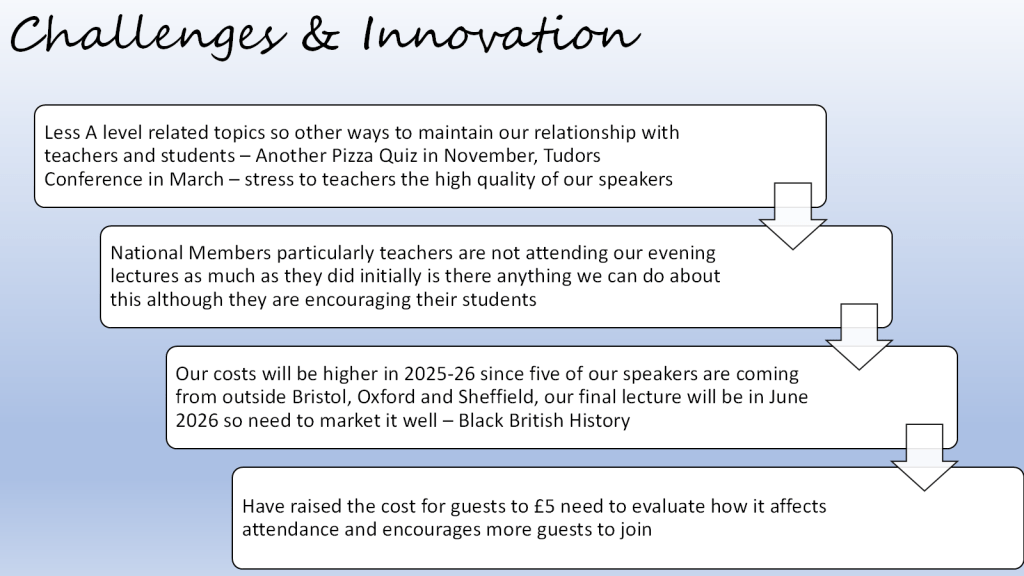
On 19th November the Bristol Branch of the HA ran its second Pizza Quiz for local Sixth Formers.  As with our first event in June we had a large number of teams from local schools taking part.  The format was very similar to a pub quiz but with free pizza instead of drinks and it again took place at Bristol University.  Students from the PGCE course at Bristol acted as marshals for the quiz.  Mary Feerick, Rob Pritchard (Secretary and Treasurer of the Bristol Branch) and David Rawlings from Bristol Education Department acted as quiz masters.  The rounds were on popular topics at GCSE and A level plus some local History.  Students had some forewarning about the topics so they could mug up their knowledge.  Despite a freezing cold night, we had a great turnout of almost 60 students from 7 different sixth forms and it was both competitive and fun. Many teams played their Joker on the Tudors round. The winners were the Suigan Garrison from St Mary Redcliffe School with 62 points out of a possible 72.  They were awarded Bristol HA cups. 

Teachers got in touch to thank the Branch the next day “a huge thank you for the time taken to put on such an enjoyable Pizza Quiz.   Students really enjoyed themselves and it was a lovely way to spend a Wednesday evening.” (Rebecca Griffiths, Gordano School) and “Thank you for organising and running the quiz. It was very successful and the BGS students thoroughly enjoyed it.” (Andy Jarvis, Bristol Grammar School)

Emerging from the mud: The discovery of Roman Bath Professor Sir Barry Cunliffe 12th November 2025

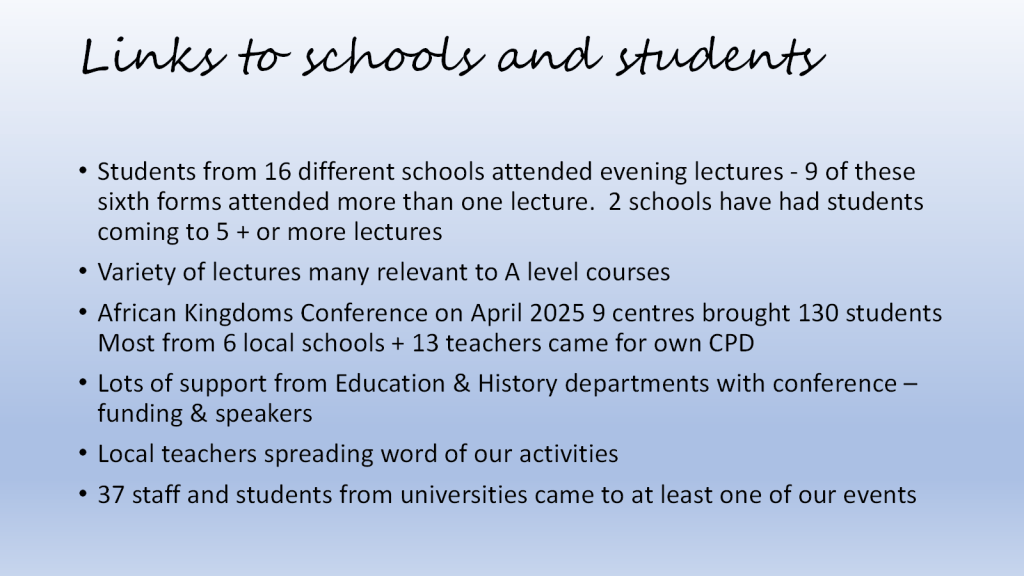
Our third lecture this year was a very special event.  We had an audience of 84, including our loyal members, guests, local teachers and 19 sixth formers from six local schools. Professor Sir Barry Cunliffe returned to the university where he had been a young lecturer in the 1960s to examine the way archaeologists, including himself, have uncovered the Roman History of Bath’s sacred spring.  This warm water spring which produces a quarter million gallons of water a day had been known since prehistoric times. 

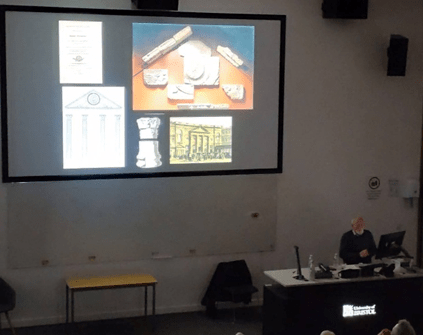
Professor Cunliffe shared maps from the 17th century when it was treated as local spectacle and the 18th century when it became a fashionable resort. During this period the gilded head of Minerva was discovered. 

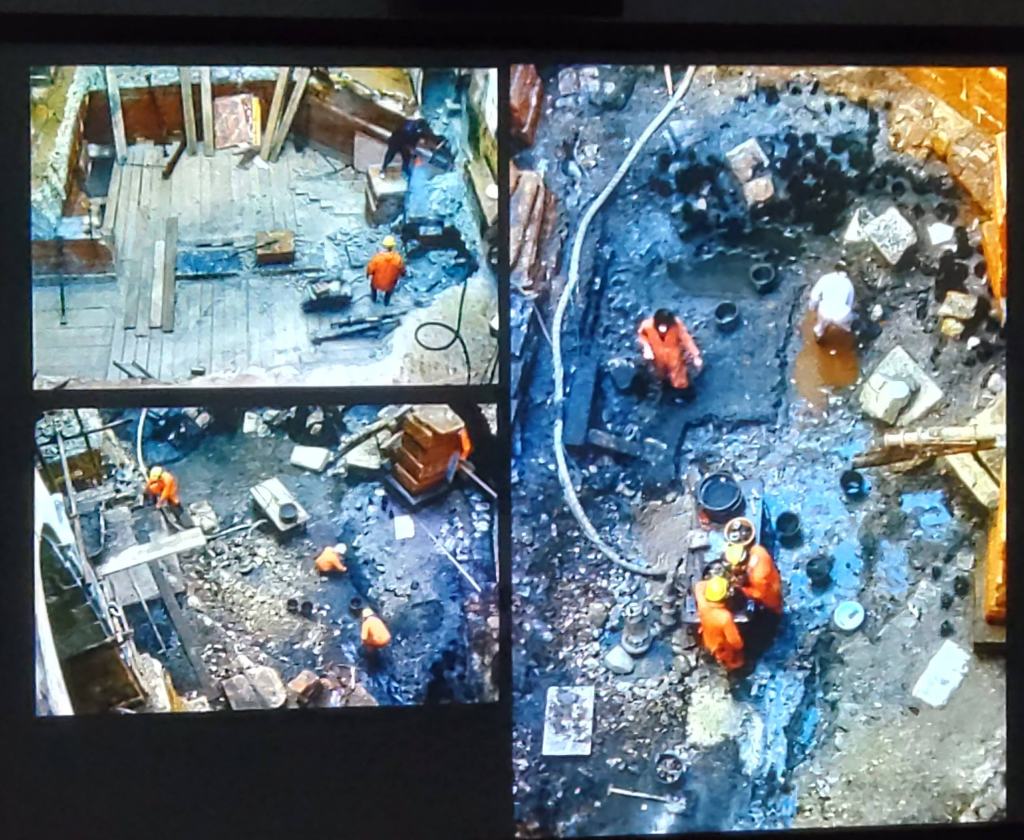
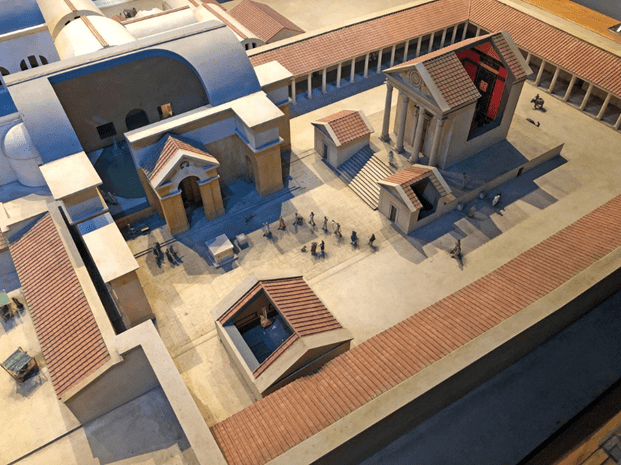
The subsequent expansion of the city meant builders uncovered much included the First century pediment of the Temple and the style of the new buildings such as John Palmer’s Pump Rooms for example, were influenced by these findings.  However, the emergence of Bath from the mud was often stop-go.  The next period of exploration involved a number of eminent Victorians including a scholarly vicar HM Scarfe, Major Davis, James Irvine, and the builder Richard Mann.  Irvine came in for particular praise from Professor Cunliffe for his detailed drawings and meticulous documentation of Roman remains, which proved invaluable for later excavations. Experts in the early twentieth century, notably Professor Francis Haverfield dismissed Irvine’s finding and in the 1950s archaeologists Toynbee and Richardson admitted they were still unsure exactly where the Roman temple in Bath had been.  In the 1960s a new phase of exploration of Bath began and Barry Cunliffe was appointed Director of Excavation in 1963 just as he had become a lecturer at nearby Bristol University.  He shared with us photographs of archaeological digs when Health and Safety had not been considered and the stunning discoveries made by archaeologists both professionals and volunteers.  His most vivid memory was of uncovering from the mud statues of two Roman gods from the corner stone of the altar (Bachus and a female figure), while above ground on Small Street he could hear a Salvation Army band playing ‘Hark the Herald angel sing.’  The excitement of archaeology was made real for our audience.  In 1974 his team were given the chance to go underneath the Pump Room and clear the cellar floor as long as it was always open to visitors.  This Temple Precinct excavation increased Bath’s visitors to one million.  Vast discoveries were made but in 1978 tragedy struck when a link was found between the water in the hot springs and a form of meningitis, leading to the closure of the baths.  However, with Health and Safety now firmly embedded the archaeologists (wearing face masks and special clothing) explored the Roman engineering that created Aquae Sulis. Barry’s enthusiasm delighted our audience. He has played a crucial role in piecing together the jigsaw that is the Roman Baths complex. We were able to share the excitement and drama as the archaeologists made new discoveries in the mud.

Ronald Hutton’s lecture on witch hunting a huge hit

Witch-hunting: Past and Present Lecture by Professor Ronald Hutton 15th October 2025

Our second lecture of the 2025-26 programme was a packed event with 147 in the audience of whom over a third were local sixth formers.  Professor Hutton began with historic definitions of witches including the familiar wicked witch of fairy tales. He presented the modern world-wide problem of witch-hunting. The scale of the modern problem astounded some of us with examples of 5,000 burnt to death in 1990s Tanzania.  The UN had now identified witch-hunting as a human rights issue.  Having set up witch-hunting’s contemporary context he took us into the past.  He covered the ancient world’s practices, including Roman persecution. However, the early Christians had not been witch-hunters so why had it re-emerged after a thousand years of Christianity and why had certain areas of Early Modern Europe been at the epicentre of this persecution?

This was a complex story but several key themes emerged in Professor Hutton’s lecture. Three great changes had preceded the outbreak of witch-hunting; the status of the devil had increased from a “minor player” in the Bible; there was new obsession with hidden groups not just the existing outsider groups and lastly there was a new interest in hidden thoughts rather than just sinful actions. As well as these underlying menaces three factors had led to an increase in witch-hunting as European Christians felt more threatened and that God was angry with them. The threat of the spread of Islam(the Ottoman Empire), the decline in the climate (colder and wetter) and the increase in disease with recurring outbreaks of plague.   Professor Hutton argued that much of these persecutions were seen as ‘daft’ by most Christians and that strong centralised powers like the Papal states, Spain, England, and France were largely immune from the scrouge of witch-hunting. However, in the numerous tiny German states and Calvinist Scotland with its local court system witch-hunting spread. The death of children tended to be blamed on witches and women were seen as the magical sex. However, in some areas other groups were identified. In Iceland 93% of the victims were men and in Normandy shepherds were likely to be identified as witches. 

So why did this persecution that claimed 40,000-50,000 lives end?  Professor Hutton argued it was seen as a failed experiment.  Pragmatically rulers saw it did not work.  Children were no healthier and the weather was no better.  Witch-hunting outbreaks did not re-occur in the same areas. The threats that had fanned witch-hunting’s flames also died down. The advance of the Ottoman Empire in Europe began to be pushed back and the climate wobbled again as the weather improved and Europe became a continent of plenty without famine by the 18th century.  Plagues also ceased, religious toleration increased and Europeans turned their attention towards colonialism.  The end of witch-hunting in Europe took over a hundred and fifty years and several stages, with vigilante attacks as late as 1940.  History gives us insights. Professor Hutton contended the lessons from Europe’s witch-hunting past are especially relevant as the struggle against modern witch-hunting continues.   The lecture was followed by some excellent questions from our audience and we finally stopped at 8.50pm.  Another successful meeting. One reviewer said ‘That was absolutely brilliant. The guy is a superstar lecturer’

Professor Selina Todd ‘Women doctors before the NHS: professional pioneers’

September 24th 2025

Our first lecture of the 2025-26 season got off to a great start with Professor Selina Todd of Oxford University sharing her fascinating research of the generation of women doctors who went into the medical profession after the initial breakthrough.  This second cohort of women numbered just over 600 by the First World War.  Her lecture concentrated on the careers of three doctors Ethel Williams, 1863-1948, Grace Stewart Billings, 1872-1957 and Marion Gilchrist, 1864-1952.  She explained the sources she used including census returns and the digitized library of the Wellcome Institute and how she was still looking for more personal papers of individual doctors. These early doctors were often supported by their sympathetic families including fathers and husbands. Scotland seems to have produced a disproportionate number of women doctors.

Professor Todd illustrated the barriers put in these qualified doctors’ path by the medical establishment. It was very hard for them to obtain clinical experience which meant that many went into general practice or public health. A question posed was were these early women doctors going into these areas because they would be accepted, they were lower paid and there was no established career ladder?  Whatever the answer there was clearly a link between these areas and the foundation of the post-war NHS.  The other barriers they faced included being blocked from senior posts and the bars placed in front of married women in institutions like hospitals.  The talk ranged outside the areas of discrimination in the profession to wider issues such as how they coped as women doctors. In some rural areas women doctors were the first people to buy cars.  There were links to the women’s suffrage movement, particularly the 1911 census protest.  Other questions asked were ‘Who they lived with?’  ‘How many of them got married and to who?’  ‘Their role in the First World War’ and the backlash they faced as men returned to the profession after 1918.  Finally, Professor Todd has investigated their relationship with the medical profession after they retired including Ethel Williams support for the next generation of women doctors and care for refugees and evacuees.  The lecture stressed that historians needed to investigate the whole lives of pioneers not just their struggles.  The audience asked some fascinating questions.   Walford Gillison shared the experience of his grandmother who had to go Scotland after her training in London to be awarded her medical degree.  Another member of the audience asked about the records female doctors had written after the Great War about their contribution to the war effort which was done so that they would not be written out of history. 

71 people attended the lecture.

African Kingdoms conference links

The following recordings were made at our conference earlier this year and may be of interest to staff and students

Here are links to the three African Kingdoms lectures from the 6th form conference:

Toby Green

Jose Lingna Nafafe

Kate Skinner

FILMS ABOUT BRISTOL 26th October 2025

I thought you and other members of the Bristol Historical Association would be interested in this forthcoming event – two films that offer unique and detailed views of Bristol. I hope to see you there. Any help in promoting this is much appreciated.

What was Bristol like in 1964 and in 1985? A rare chance to see two films on the cinema screen. 26 October 2025 12.00-17.00

Before John Boorman went on to Hollywood fame he worked in BBC Bristol making documentaries and docudramas. In 1964, Boorman helped launch BBC 2 with a six-part series about Bristol. The Newcomers is a unique view of the city in the mid-1960s at a time of national and international social, cultural, political and economic change. It is centred around the lives of Alison Kennedy, who came to Bristol as a student, and Anthony Smith (ACH Smith), who came to work for the Bristol Post and then Western Daily Press.

They met by chance, married, and Bristol became their home and where they started their family. Many familiar faces from Bristol at the time feature, including playwright Tom Stoppard. The real star is the city of Bristol itself.

The series covers, among others, capital punishment, work and housing, docks labour, a dodgy pub, night life (where Stoppard dances the Hippy Hippy Shake at The Glen), NHS and the welfare state, homelessness, an evangelical church in St Paul’s, trying to make a living as an artist, crime and policing, what it means to live the good life in Bristol and cities generally. There’s fewer cars and a lot more smoking. There’s even a brief glimpse of Raghbir Singh, the first Sikh bus conductor to be employed by the Bristol Omnibus Company following the bus boycott in 1963.

Following the screening of the complete The Newcomers, we will show Money Into Light, where Boorman returns to Bristol 25 years on and revisits the places he worked in and filmed.

Book here: https://ti.to/film-noir-uk/johnboorman

Visit from Hannover to Bristol 23rd July 2025

In July we were delighted to welcome the Historical Society of Lower Saxony from Hannover. They spent a week in Bristol. The group also visited Bath, Wells and Glastonbury. Hannover has been Bristol’s twin city in Germany since 1947.

On 23rd July Rob did a talk at the University entitled ‘Bristol Gateway to the New World’ which included a discussion of the roots of Bristol’s prosperity and of course the links to the Slave Trade.

In the afternoon Rob led a three hour walking tour of the medieval city.

A very full day!