Patrick Bishop puts the Battle of Britain in perspective

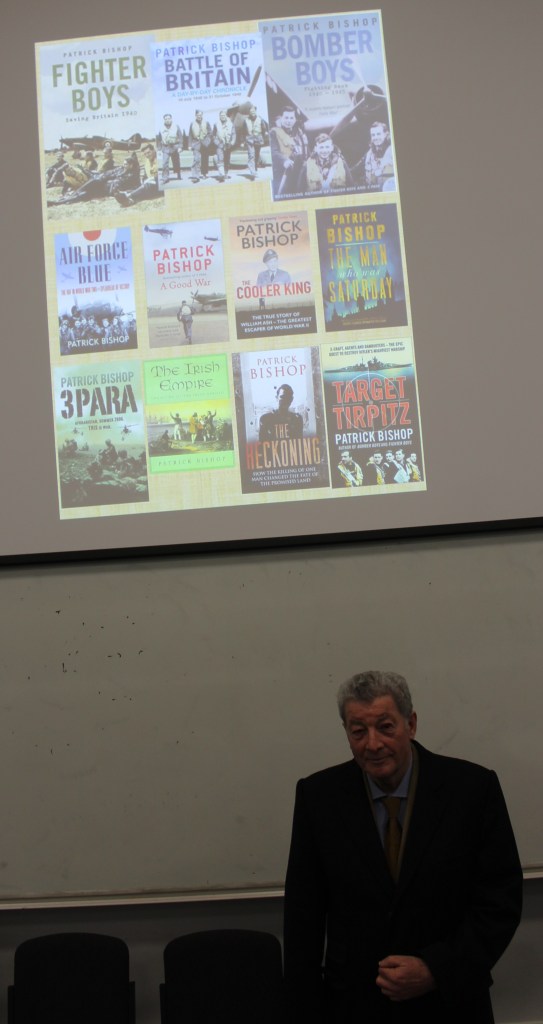
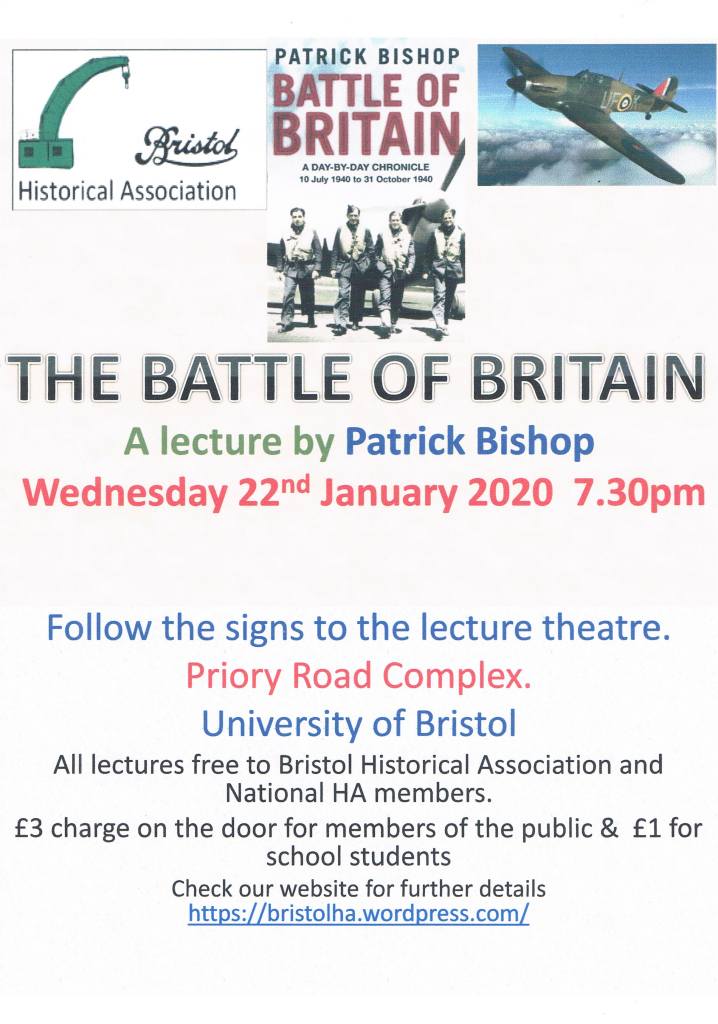
Patrick Bishop began his talk with a story about two pilots. The second of these was Ian Hutchinson. Having been shot down and hospitalised he was making his way home on public transport carrying his parachute under his arm and with only one shoe. Members of the public kept coming up to him just to touch him and show their gratitude for what the RAF were doing. The member of ‘the few’ described the it has highly embarrassing. One of Patrick Bishop’s great achievements is that he interviewed so many of the pilots who took part in the Battle of Britain and then using his experience as a journalist and historian presented a truly human story of this epic struggle. His lecture showed how the young men and women of 1940 did not appreciate the historical significance of the events they were participating in. They came from a wide range of backgrounds and did not see themselves as heroes. They were often very young and their life expectancy was very short. The longer they flew the better their chances of surviving the high speed and high altitude conflict. Meanwhile on the ground below them (particularly in Kent and London) the British people watched the specks shooting around the summer and early autumn skies leaving vapour trails behind them. Particularly striking was how he developed the argument that the Battle of Britain became the Battle for Britain; a post war more egalitarian society. There were many well informed questions from our audience including what the Luftwaffe thought of the Battle of Britain.

Membership soars.

As of January 17th 2020 membership of the Bristol Historical Association has reached 54. We also have 72 national Historical Association members in the Bristol area. This means we effectively have 126 local members. Not bad considering we only started in September 2017.

The Rise and Fall of the Welfare State

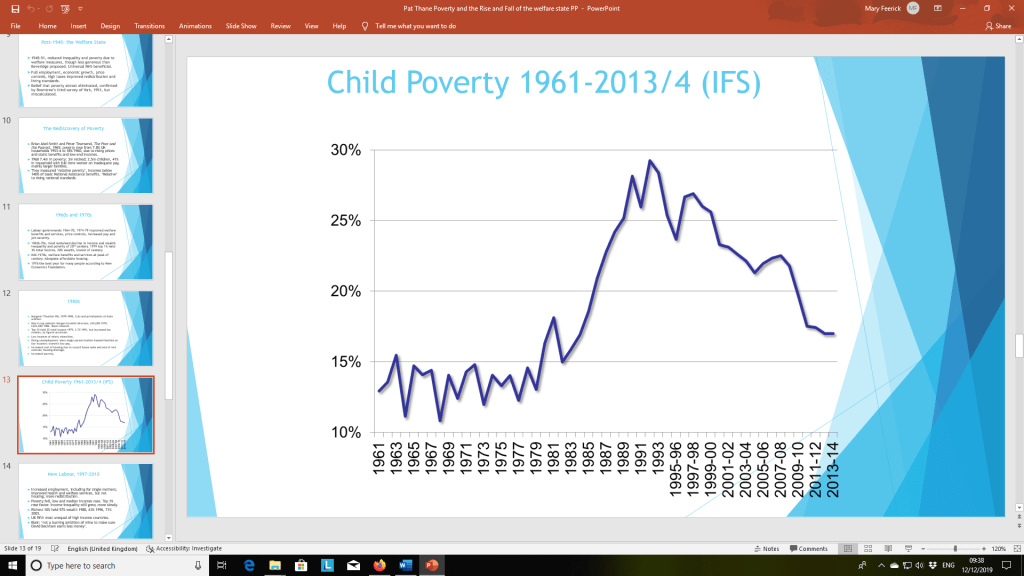
Professor Pat Thane came down from London to deliver an excellent lecture on the rise and fall of the Welfare State which highlighted the poverty investigated by Booth and Rowntree at the beginning of the twentieth century and concluded with some startling figures on the rise of poverty from the secure period of 1945- 1970’s to its present very high point.  Mastering an array of statistics Professor Thane showed us how child poverty had returned in most of the audience’s life times and many of our preconceptions about life in the 1970’s were challenged.  Inevitably it led to some lively questions at the end of her talk and some real debate. It was a thought-provoking contrast to last month equally impressive lecture on Mrs Thatcher by Dominic Sandbrook as this lecture showed how the Thatcher years began the dismantling of the Welfare State.  It also showed how relevant History can be to understanding the society we now live in, including the rise in homelessness and foodbanks. To quote one of our members Ann Carpenter “I have thoroughly enjoyed the program thus far (particular as I have been able to share social politics and history with my daughter Nat) I’ve been inspired to do further reading after the last two fascinating talks. Very much enjoyed listening to Pat Thane tonight.”

Should we judge historical figures by the morals of today? The Great Debate. Wednesday 27th November 2019.

The Great Debate – Bristol Heat 2019 27th November 2019

Last night twelve South West History Students from ten different schools and colleges took the stand to present their arguments on whether or not we should judge historical figures by the morals of today.  Our contestants each spoke for five minutes and then faced five minutes of questions from our distinguished panel of judges Adam Vaitlingham QC, Professor Madge Dresser and Dr Evan Jones.  The audience made of their parents and supporters listened as students from the Bristol area;  Bristol Grammar School, Redland Green School, Redmaids High School, Badminton School, Clifton College and from further away Norton Hill School Radstock, New College Swindon, The Cotswold School in Bourton-on-the-Water, from Bath  Hayesfield School and Bath RHS all made their arguments.  Naturally the name of Colston came up more than once but the students impressed us with range of their knowledge including arguments about Aristotle, Alan Turing, Churchill, Queen Elizabeth, Boudicca, and Neville Chamberlain.  It was a difficult decision for our judges but there could be only one winner.  In joint third place were Scarlett Carter (Badminton) and Darcey Gresham (Bath RHS); in second place our youngest contestant Callum Wooley (The Cotswold School) and in first place and going through to the national final at Windsor Castle Tobey Ahamed-Barke (RGS).  But all our contestants Katie Stubbs, Grace Hillier, Jess Davis, Josh Anthony, Zac Fairbrother, Joshua Turner, Elise Preedy and Jack Goldsack deserve our congratulations with some fascinating arguments.   

Dominic Sandbrook wows the Bristol HA.

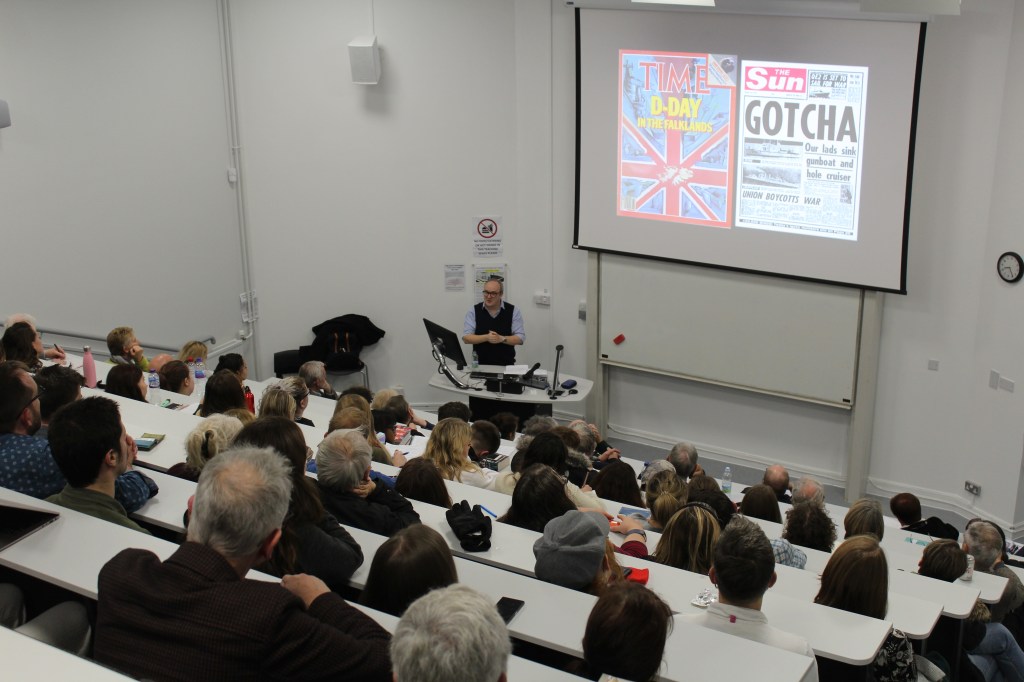
Nearly ninety people came to hear Dominic Sandbrook talk about Mrs Thatcher and the Falklands War.

Author and broadcaster Dominic Sandbrook gave a brilliant lecture on the early Thatcher years to the Bristol Branch of the HA last night.  While it poured with rain outside, a packed lecture hall heard a really lively examination of the period from 1979-82 through which some of the audience had lived and others were studying.  The lecture painted a vivid portrait of Britain in the late ‘70’s beginning with how the world viewed Britain (starting with Fawlty Towers). We were taken on a journey through the impact of computers and microwaves to the Falklands War of 1982. Dominic reminded us just how much Mrs Thatcher regarded herself as an outsider in the male, privileged Conservative party of which she was leader. She was a grammar school girl who had studied science and came from a Methodist background.  Younger audience members were clearly shocked at the emphasis on appearance female politicians faced in that era.  We were shown images of men and women from television and the tabloid newspapers. This was the background to 1982. The Falklands War was obviously a turning point. Dominic Sandbrook challenged many of the assumptions about Thatcherism and faced many very informed questions from our audience who as usual had more questions than we had time for!!!

Stalin & Putin

167 people attended Dr James Ryan’s lecture on Wednesday 16th October 2019.

Reckoning with the Past: Stalin and Stalinism in Putin’s Russia.

Dr Ryan’s research has included opinion polls in Russia and interviews with Russians. Over the last decade Stalin has been reinstated as a great Russian leader. Putin’s regime has focused in particular on Stalin’s role in the defeat of Nazi Germany. Unlike Lenin whose revolution unsettled Russia, Stalin stood for unity and stability.

Our season began with a packed room for Dr Ryan Hanley’s talk on the links between working class radicalism and the Slave trade debate.

•’We shall not be slaves’ was the refrain at Peterloo but what was the attitude of the British ‘working class’ to the slave trade and (after 1807) slavery? Dr Hanley showed how the abolition movement tried to distance itself from ‘French’ inspired radicalism and how the pro Slavery movement tried to shift attention from the slaves in the West Indies to the plight of the poor in Britain.

The Making of Women’s History

In our final lecture of 2018-19 Professor Kate Dossett of Leeds University presented a fascinating insight into the way archivists are preserving the materials of the Feminist past.  Drawing on her research with FAFF (Feminist Archives Feminist Futures) Kate Dossett challenged the image of Feminist History as a series of waves pushed back over the last century and a half.  This metaphor of waves tended to put each generation of Feminists at with odds with the earlier generations. She showed how archives as diverse as the Fawcett Society (now the Women’s Library) and the Glasgow Women’s Library were preserving through books, news clippings, artefacts, pamphlets, posters, film and oral history the history of the Feminist Movement.  This included ant-Feminist materials to give the topic context.  This lecture not only enlightened us about Feminism’s History and also examined the wider issue of how historians and generations revisit and take ownership of the past.  It was lively and inspirational end to our second successful year.IMG_1691IMG_1688