Author: bristolha
Back to the Seventies.
Wednesday 16th January 2019. In our first lecture of 2019 Dr James Freeman took us back to the 1970’s and showed us how in many ways there were parallels with the austerity of the 2008-2018 period. He also showed how Euro Scepticism and Brexit had links with the 1970s and how misrepresentation by the British media and more recent British politicians of this decade is still part of our political story. He explored some of the key differences as well. Our members took part in a lively question and answer session at the end of the lecture, many sharing their personal experiences of life in the 1970’s. It was a really good start to 2019.


How Mary got into History
Our Secretary asked to write “How I got into History” article for The Historian
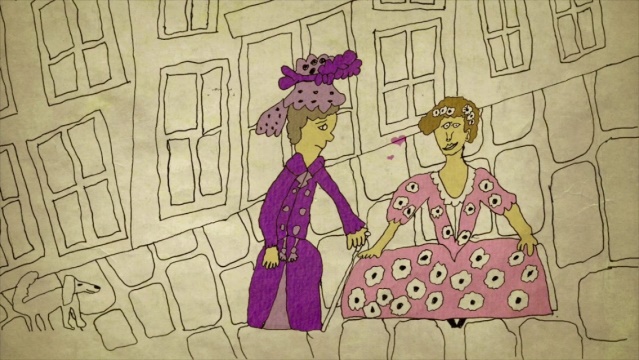
Since our branch is becoming well-known our Secretary Mary was asked to write a short column on how she got into History for ‘The Historian’ by Rebecca Sullivan the CEO of the Historical Association. This will come out later this year and Mary’s article about how a little girl with no background in History and few books in the house was drawn into History will be recognisable to all her former students and colleagues as personal, a little sentimental but also totally Mancunian. Once it is out in the Historian we will reprint it on local website but here is the photo that goes with the article for now.

Tony Badger praises the Bristol HA
Bristol Branch of the HA praised by HA President Professor Tony Badger
At the November Annual Meeting of the Branch Officers of the Historical Association the Bristol Branch was praised, along with the Humberside branch, as one of the fastest growing and most active branches in the country. This is down to you our loyal members and supporters and of course to all the help we have had from speakers especially from Bristol University. We have come a long way in just eighteen months.
The campaign for Women’s votes in Bristol
During the summer of 2018 our secretary Mary Feerick worked on an HA government funded project on Women’s Suffrage. Mary’s research involved researching and producing resources for a digital map of the city showing key sites connected with events and individuals in the struggle for the vote. Mary worked with the ‘Know Your Place’ team of Ruth Myers and Pete Insole. Mary also produced material about Annie Kenney and Emmeline Pankhurst and less well known but relevant figures in Bristol’s role in the struggle for women to get the vote. There are four lessons covering Why did some women in Bristol want the vote in 1866? How effective was the campaign in the 1870s and 1880s? How was the campaign re-invigorated after 1897? How active and successful were suffragists and suffragettes in Bristol 1897–1914? The materials are now on-linehttps://www.suffrageresources.org.uk/activity/3214/how-effective-was-the-votes-for-women-campaign-in-bristol and could easily be adapted for use by local schools. Do get in touch in you want more details.
Stawberries and cream
Revolution in the air
Wednesday 28th November 2018
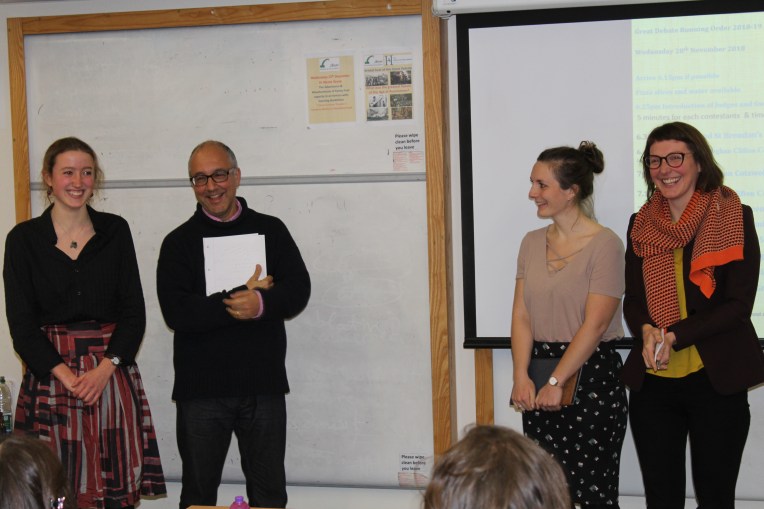
On a stormy night in Bristol ten sixth formers impressed our judges with their arguments about ‘What was the greatest failure in the Age of Revolutions?’
Students from eight sixth forms battled for a place in the final at Windsor Castle. The winner was Beth Eastwood-Dewing from Gordano School but all the contestants impressed our three judges Adam Vaitilingam QC, Dr Amy Edwards and Dr Erica Hannah and our distinguished visitor Major General Sir Evelyn Carter-Webb of the Waterloo 200 Trust who funded the competition.


Our Harry
Wednesday 14th November 2018
Record turnout for Henry VIII
An audience of over 200 filled the Priory Road Lecture theatre for the second meeting of this year’s Bristol Branch of the Historical Association . Tracy Borman’s lecture on Henry VIII and the men who made him was bound to be popular but this was also thought provoking. Dr Borman wanted to shift the emphasis away from the usual discussion of the six wives and instead focus on the men in Henry VIII’s life. Some were well known figures like Cardinal Wolsey, Thomas More and Thomas Cromwell but others less so like his tutor John Skelton, his fool Will Sumner and his best friends Charles Brandon and Sir Francis Bryan known as the Vicar of Hell. The audience followed the lecture with lots of questions including a fascinating question from Peter Greenhouse who asked Tracy Borman about the theory about Henry VIII’s syphilis which might have caused the deaths of his children by Catherine of Aragon.

Madge Dresser’s Bristol Slave Trade walk
Saturday 10th November 2018
A huge thank you to Madge Dresser for leading a fabulous walk around Bristol where we looked at Bristol’s involvement in the Slave Trade. This is a subject which has come alive in Bristol in the last few months. Madge has done more than anyone else to ensure that the debate is an informed one. Many of us have had to rethink our views as a result of Madge’s walk.

12th