Professor Selina Todd ‘Women doctors before the NHS: professional pioneers’

September 24th 2025

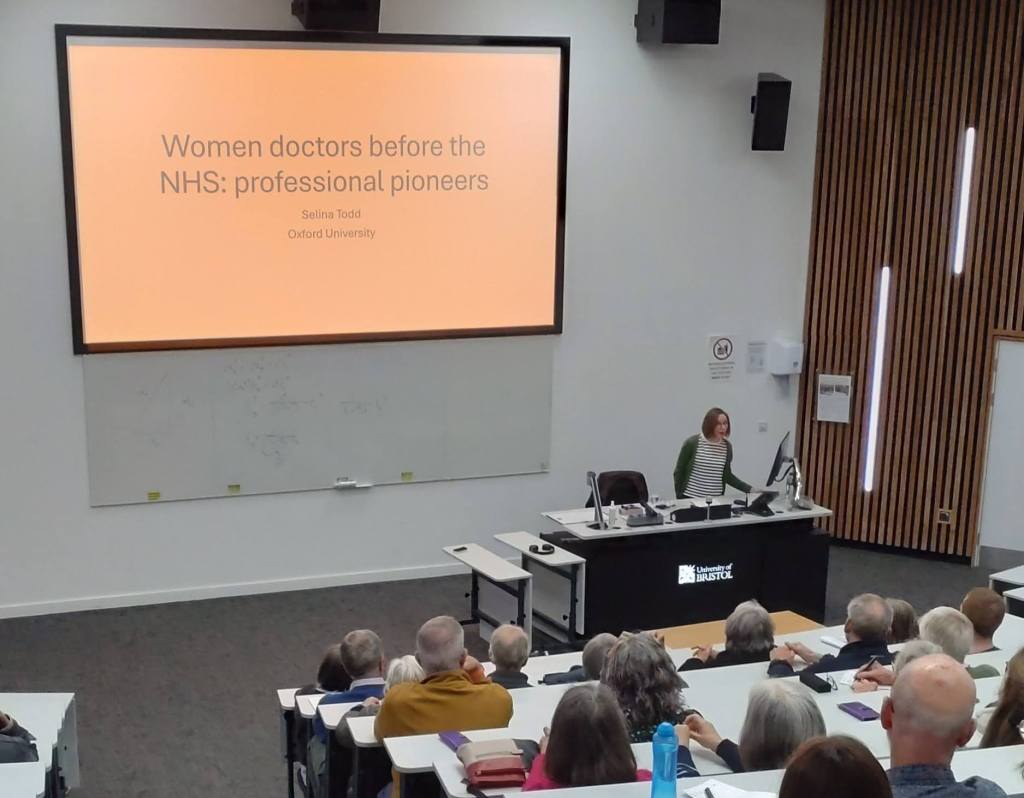
Our first lecture of the 2025-26 season got off to a great start with Professor Selina Todd of Oxford University sharing her fascinating research of the generation of women doctors who went into the medical profession after the initial breakthrough.  This second cohort of women numbered just over 600 by the First World War.  Her lecture concentrated on the careers of three doctors Ethel Williams, 1863-1948, Grace Stewart Billings, 1872-1957 and Marion Gilchrist, 1864-1952.  She explained the sources she used including census returns and the digitized library of the Wellcome Institute and how she was still looking for more personal papers of individual doctors. These early doctors were often supported by their sympathetic families including fathers and husbands. Scotland seems to have produced a disproportionate number of women doctors.

Professor Todd illustrated the barriers put in these qualified doctors’ path by the medical establishment. It was very hard for them to obtain clinical experience which meant that many went into general practice or public health. A question posed was were these early women doctors going into these areas because they would be accepted, they were lower paid and there was no established career ladder?  Whatever the answer there was clearly a link between these areas and the foundation of the post-war NHS.  The other barriers they faced included being blocked from senior posts and the bars placed in front of married women in institutions like hospitals.  The talk ranged outside the areas of discrimination in the profession to wider issues such as how they coped as women doctors. In some rural areas women doctors were the first people to buy cars.  There were links to the women’s suffrage movement, particularly the 1911 census protest.  Other questions asked were ‘Who they lived with?’  ‘How many of them got married and to who?’  ‘Their role in the First World War’ and the backlash they faced as men returned to the profession after 1918.  Finally, Professor Todd has investigated their relationship with the medical profession after they retired including Ethel Williams support for the next generation of women doctors and care for refugees and evacuees.  The lecture stressed that historians needed to investigate the whole lives of pioneers not just their struggles.  The audience asked some fascinating questions.   Walford Gillison shared the experience of his grandmother who had to go Scotland after her training in London to be awarded her medical degree.  Another member of the audience asked about the records female doctors had written after the Great War about their contribution to the war effort which was done so that they would not be written out of history. 

71 people attended the lecture.
African Kingdoms conference links

The following recordings were made at our conference earlier this year and may be of interest to staff and students

Here are links to the three African Kingdoms lectures from the 6th form conference:

Toby Green

Jose Lingna Nafafe

Kate Skinner

FILMS ABOUT BRISTOL 26th October 2025

I thought you and other members of the Bristol Historical Association would be interested in this forthcoming event – two films that offer unique and detailed views of Bristol. I hope to see you there. Any help in promoting this is much appreciated.

What was Bristol like in 1964 and in 1985? A rare chance to see two films on the cinema screen. 26 October 2025 12.00-17.00

Before John Boorman went on to Hollywood fame he worked in BBC Bristol making documentaries and docudramas. In 1964, Boorman helped launch BBC 2 with a six-part series about Bristol. The Newcomers is a unique view of the city in the mid-1960s at a time of national and international social, cultural, political and economic change. It is centred around the lives of Alison Kennedy, who came to Bristol as a student, and Anthony Smith (ACH Smith), who came to work for the Bristol Post and then Western Daily Press.

They met by chance, married, and Bristol became their home and where they started their family. Many familiar faces from Bristol at the time feature, including playwright Tom Stoppard. The real star is the city of Bristol itself.

The series covers, among others, capital punishment, work and housing, docks labour, a dodgy pub, night life (where Stoppard dances the Hippy Hippy Shake at The Glen), NHS and the welfare state, homelessness, an evangelical church in St Paul’s, trying to make a living as an artist, crime and policing, what it means to live the good life in Bristol and cities generally. There’s fewer cars and a lot more smoking. There’s even a brief glimpse of Raghbir Singh, the first Sikh bus conductor to be employed by the Bristol Omnibus Company following the bus boycott in 1963.

Following the screening of the complete The Newcomers, we will show Money Into Light, where Boorman returns to Bristol 25 years on and revisits the places he worked in and filmed.

Book here: https://ti.to/film-noir-uk/johnboorman

Visit from Hannover to Bristol 23rd July 2025

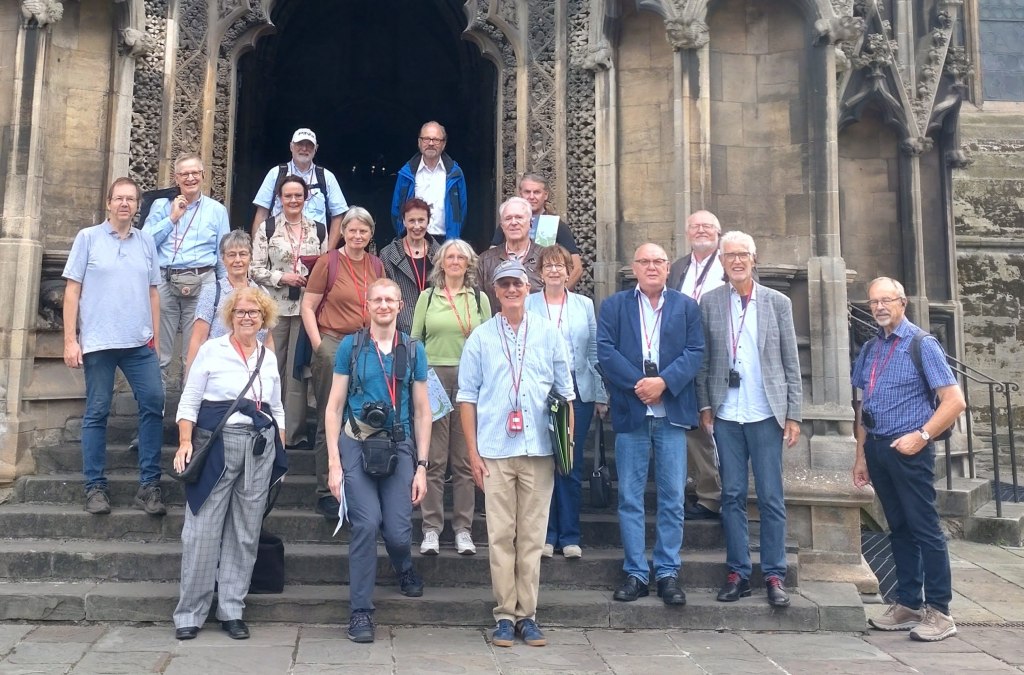
In July we were delighted to welcome the Historical Society of Lower Saxony from Hannover. They spent a week in Bristol. The group also visited Bath, Wells and Glastonbury. Hannover has been Bristol’s twin city in Germany since 1947.

On 23rd July Rob did a talk at the University entitled ‘Bristol Gateway to the New World’ which included a discussion of the roots of Bristol’s prosperity and of course the links to the Slave Trade.

In the afternoon Rob led a three hour walking tour of the medieval city.

A very full day!

Outreach

Last Thursday (3rd July) Mary Feerick did a talk to the Trinity Community Services Lunch Club entitled ‘Bristol Wives and Girls in the 1970s’

Over the past few years Mary and Rob have been out to talk to lunch clubs and local history groups including…

Trinity Lunch Club, The Corner Club, Bristol and Avon Family History Society, Knowle and Totterdown Local History Society, Bristol Foster Carers (Speedwell), Bristol Civic Society, Clifton Rotary Club and the Vintage and Classic Motorcycle Club.

More details of the talks we do are on our website. We do not charge for these events.

Sixth form pizza quiz

Wednesday 25th June 2025

60 Bristol sixth formers attended our pizza fuelled history quiz in the Reception Room of the Wills Memorial Building. A big thankyou to the history teachers who encouraged their students to take part. There were 15 teams from six schools. After eight rounds a team from St Mary Redcliffe came first.

Did Khrushchev destroy the USSR? by Dr Daria Mattingly

Our penultimate lecture this year focused on Nikita Khrushchev the leader of the post-Stalinist Soviet Union.  The lecture began with a lively focus on the film The Death of Stalin (2017).  Stalin had left no instructions for what would happen after his death and after a power struggle Khrushchev emerged as the leader.  Daria covered the release of prisoners from the Gulag, his ‘secret speech,’ the reforms he introduced often referred to as The Thaw, the regional autonomy that emerged and the progress of the Cold War.  The extent of the Gulag was revealed not only by the numbers imprisoned but the massive network of camps.  The contradictions of the Secret Speech given to a party who knew only too well what they had been involved in were illustrated by how Khrushchev tackled the question of why he had not spoken out, when none of the others in the party congress had either.  Daria showed how this speech affected those in the Eastern Block.  She examined the economic reforms including the low cost housing ‘Khruschevski’, the import of food but also the failure of the Virgin Lands reforms.  The picture that emerged of Khrushchev was of two steps forward, one step back reformer.  A key insight was the emphasis on regional autonomy which in the long term would be a major factor in the fall of the USSR.  This regional autonomy would lead to 300,000 Ukrainians forming a human chain stretching 482 km (300 mi) from Kyiv to Lviv in 1990. The lecture linked the fall of USSR to the limits of Khrushchev’s reforms but also the key question of why the USSR fell but Communist China has survived.  It was followed by a very informed Q&A session which included a strong discussion of how the celebrations of the Great Patriotic War were not a feature of either the Stalin post-war era or Khrushchev’s unlike that of Brezhnev or Putin.  Our audience of 54 included 16 local sixth formers from 4 schools and nine guests who we hope will become members next year.

CELEBRATING THE 1963 Bristol BUS Boycott and the 1965 RACE REALTIONS ACT

Designs4Change competition. 

Together Curiosity Un(Ltd) and Bauer Media Outdoor are looking to select 10 winners whose work will feature across a national network of digital screens for 6 weeks from August 14th until September 30th. Celebrating 60 years of the Race Relations Act 1965, millions will see the winners’ work at bus stops, shopping malls and train stations across the country. The ten winners will share in a prize with a media space valued at £100k+ as well as other prizes. 

If you know of any emerging or established artists who are 18+ who doodle, draw or design then we need your help to amplify this amazing opportunity across your networks in the following ways:

  • Write a news feature or blog 
  • Include a short story in your external or internal newsletter (copy can be found in the social toolkit)
  • Connect with us if you have any other ideas

Words4Change

For aspiring wordsmiths, we’ve launched Words4Change. Inspired by the iconic I Have A Dream speech by Martin Luther King, this competition is looking for 3 poets to proudly celebrate equality, justice and inclusion.  Words4Change is powered by The Diverse Artist Network, Quartet and Curiosity Un(Ltd). To submit your poem goto www.CuriosityUnLtd.com. The competition closes at midnight September 12th. T&Cs apply. Goodluck! 

Finally, if you’re a corporate, civic or community changemaker we invite you to make a PLEDGE to join our audacious and historic bid to bring Martin Luther King III (son of MLK) to the UK. Celebrating the Race Relations Act 60 years to the day it became law, this major finale event will take place in November at the prestigious Wills Memorial Building in Bristol. We invite you to be part of this historic opportunity as a sponsor, funder, co-creator, amplifier or volunteer. PLEDGE and you’ll be joining a growing movement bidding to bring MLK III to the UK. For your inspiration you can check out what MLK III has to say about coming to the UK.