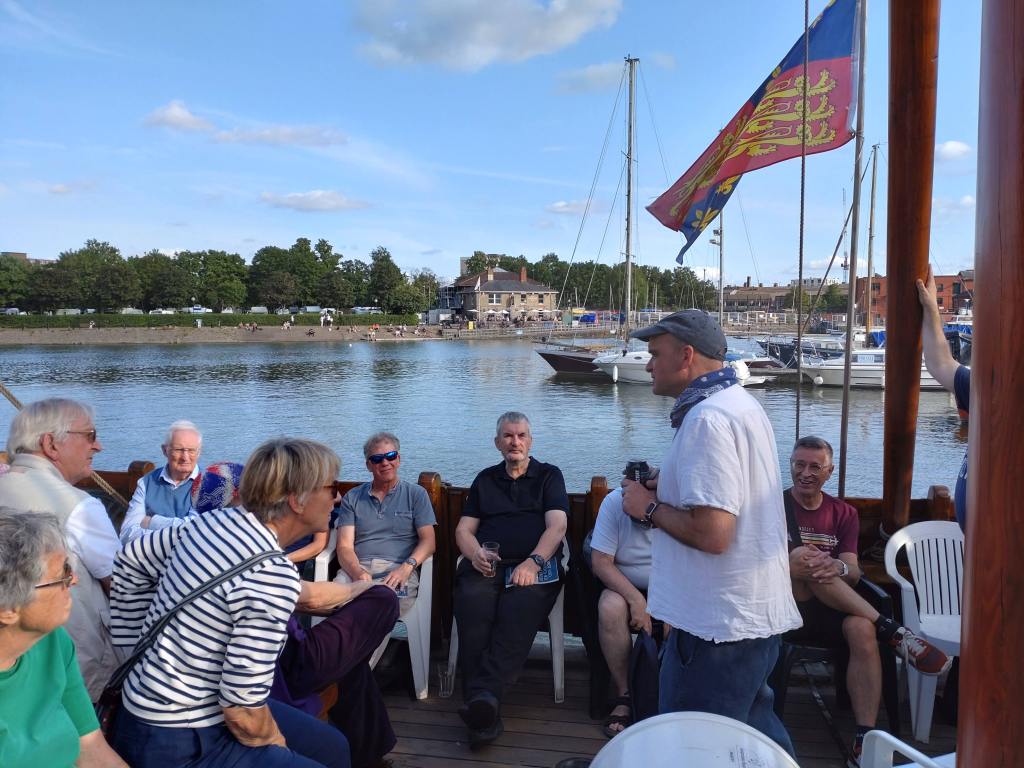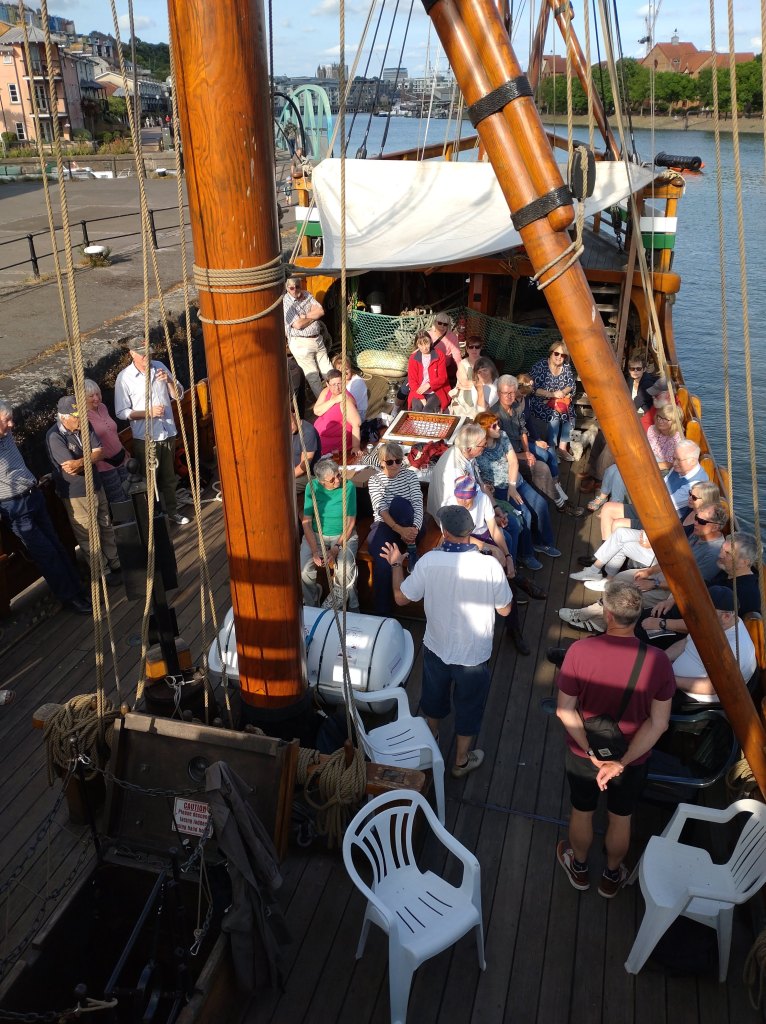
Thirty eight Bristol HA members enjoyed a leisurely early evening cruise around the harbour on the Matthew. Evan Jones gave several enthralling talks on John Cabot’s 1497 and 1498 voyages to Newfoundland and what life would have been like for the crew. There was the added bonus of a bar and a fish n chip supper. A great way to end the 2022-23 season.
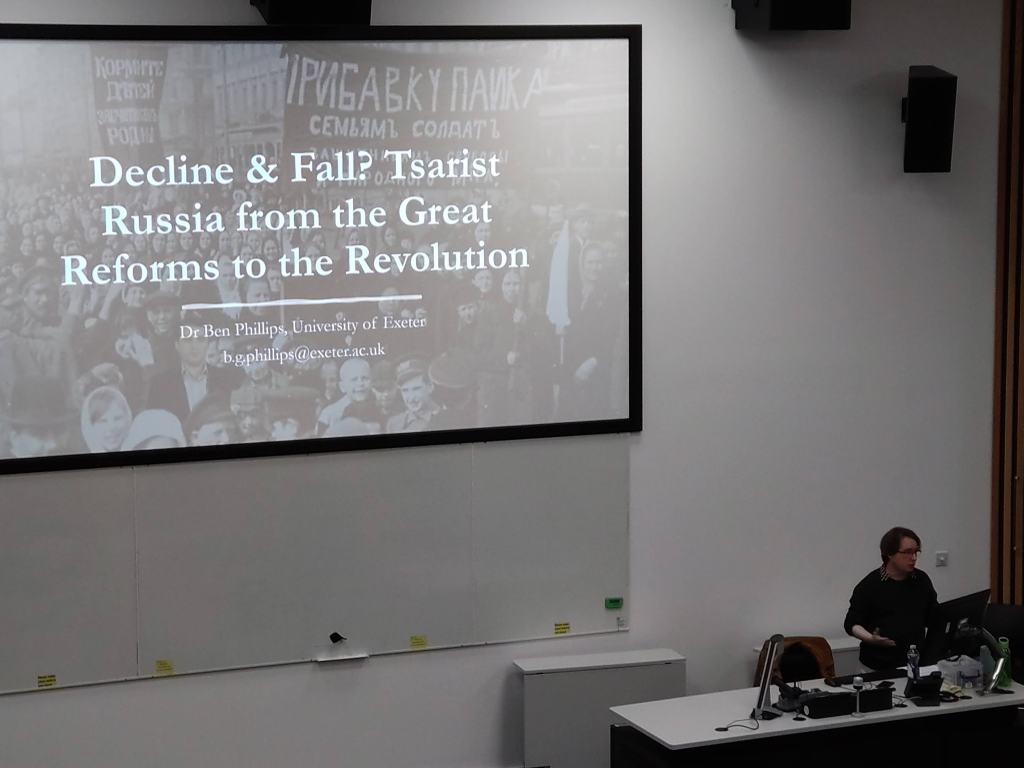
Sixty six people attended Ben’s lecture including students from seven schools. Ben’s lecture looked at the arguments around the fall of Tsarism. The optimists argue that the regime could have been saved were it not for the First World War. The pessimists argue that it was doomed. English absolutism was destroyed at the end of the seventeenth century and French absolutism at the end of the eighteenth century. The Russian victory over Napoleon lulled the Tsars into a false sense of security. Rather than looking at the characters of individual Tsars, Ben chose to examine the problems caused by social and economic upheaval, defeat in war, non-Russian nationalism and revolutionary agitation. He examined the role of key ministers such as Witte and Pobedonostsev. The emancipation of the serfs in 1861 had many unforeseen consequences not least the further impoverishment of the peasants and the alienation of the nobility and gentry. Ben suggested the Polish revolt of 1863 was another warning that went unheeded. In the 1905 revolution many of the key areas of unrest were in non-Russian areas of the empire. Thank you to Ben for putting Tsarist Russia into perspective and for coming all the way from Exeter.
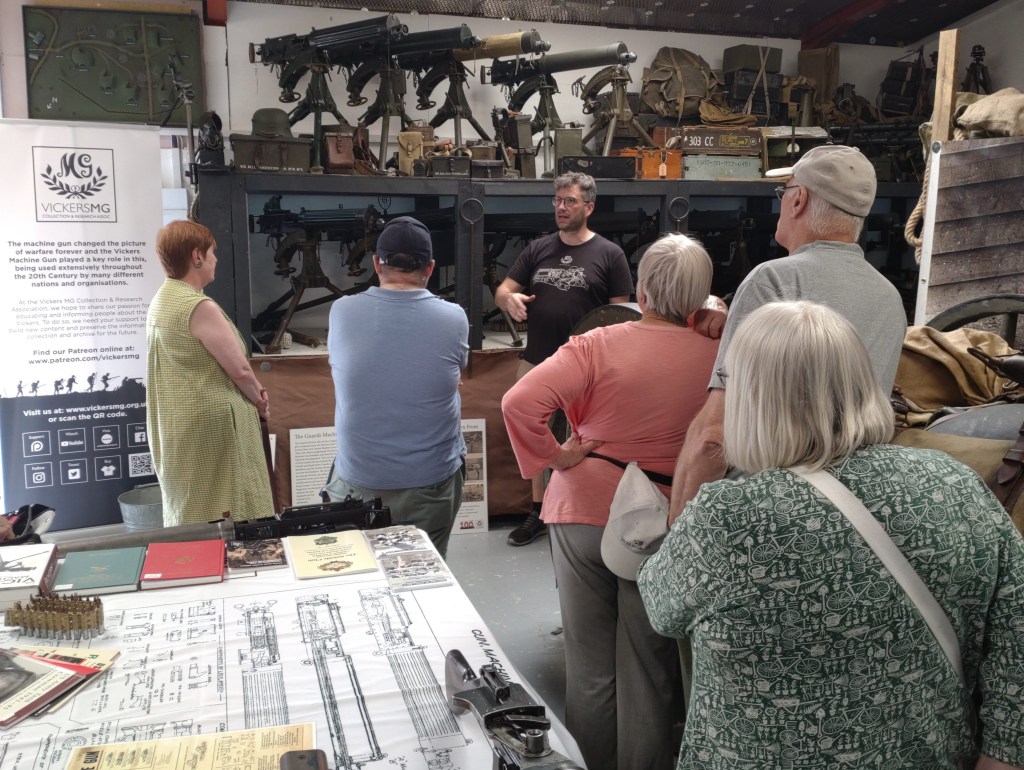
A dozen Bristol HA members visited the Vickers Machine Gun collection at a secret location in Wiltshire. For security reasons we thought we might have to be blindfolded for the last part of the journey. A big thanks to Dave Voisey for inviting us and Rich Fisher for showing us around.
In the three hour visit Rich treated us to live firing demonstrations using a Vickers MG, Bren gun and Lee Enfield. The Vickers machine gun was used by the British Army from 1912 until 1968. Rich gave a brilliant talk about the manufacturing process. This included how the gun was simplified to cope with a shortage of skilled labour. The mighty Vickers company lasted from 1828 until 1999 and built guns, ships, aircraft and much more. Rich showed us how the gun was assembled using parts from all over the country including ammunition belts made by a curtain tape manufacturer. Before 1914 the Germans had to pay Vickers who held the licence for the Maxim-Vickers gun when they produced their version of the gun.
Vickers machine guns were a major British export. Rich showed us Vickers machine guns that had been supplied to many countries including the USA, Egypt, Turkey and Chile. The machinations of the arms trade in the 1930s was investigated by the Fabian Society who showed how the arms manufacturers, banks and diplomatic service worked together.
In the First World War a Vickers machine gun had a crew of eight. Richard went through the different skills that were required by members of the team which included a numerate rangefinder, an athletic ammunition carrier and horse handlers. When the gun jammed (we were firing blanks) he showed us how it had to be rapidly dismantled and reassembled.
The museum is a kind of prism through which we can study many aspects of British history in the first half of the twentieth century. It was quite a unique visit and the whole Bristol HA crew were captivated by Rich’s demonstrations and explanations.
We are very sorry to say that due to unforeseen circumstances our lecturer has had to postpone/cancel the lecture on Tsarist Russia on Wednesday 17th May.
We are hoping that we can reschedule it for later in the term. Please keep an eye on our website.
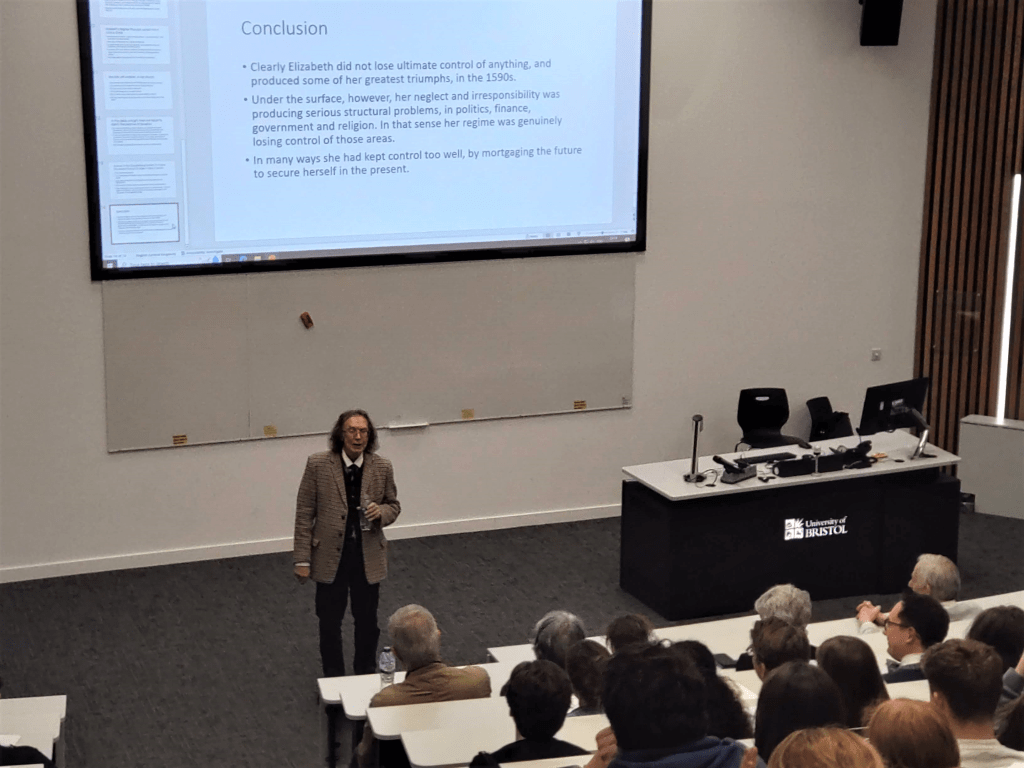
Professor Hutton gave another highly popular and relevant lecture for the Bristol Historical Association with our biggest audience this year, 136 including 91 local students from ten schools. Professor Hutton tackled what has been known among Tudor historians as the “neglected nineties.” He opened by giving a clear picture of all the lasting achievements of Elizabeth that were well in place in the 1590’s, after forty years of successful rule, including a poor relief system, good relations with England’s traditional enemies and the extension of the Crown’s powers. However, he then began to chip away at our familiar picture by outlining some of problems of the decade. He argued that the deaths of many of her most reliable courtiers like Raleigh, Burghley and Leicester made her a more marginalised figure. Her weakness for “silly young men with gorgeous legs” reached its height with the worst of them of all, the Earl of Essex so “chronically stupid” he should never have been allowed a role in political life.
A rather tragic picture of an elderly queen was presented from the perspective of foreign ambassadors who commented that she was still dressing like a young woman and jealous of her ladies in waiting who were young and attractive. The court was reported as “weary of old woman’s government.” More importantly the onset of corruption and selling of offices painted a picture of government shoring up problems that the Stuarts would be faced with. Underpaid crown servants had to use corruption to pay their staff and even the upright Burghley and his son were part of this system. By the late 1590’s corruption was endemic and Edmund Spencer declared “nothing was done without a fee”. When Parliament faced Elizabeth with the problem in 1601 and a bill to deal with it, she managed to talk her way out of the situation with her customary political skill but the problem remained. Similarly religion was presented as not the grand compromise but an unresolved problem that other national Protestant states had worked out. As a result, at the end of Elizabeth’s reign new destabilising movements were massing. The Arminianism versus Puritanism conflict was gathering force. The religious fault lines divided counties (such as the East and West Ridings of Yorkshire) and parishes.
The conclusion was that Elizabeth never lost ultimate control and retained her charisma and intelligence but the problems that were amassing under the last years of her rule were an explosion waiting to happen in the seventeenth century. Her successful reign had mortgaged the future of her kingdom. After this thought provoking lecture there was a range of very well informed questions from the audience and some decisive and witty replies from our speaker.
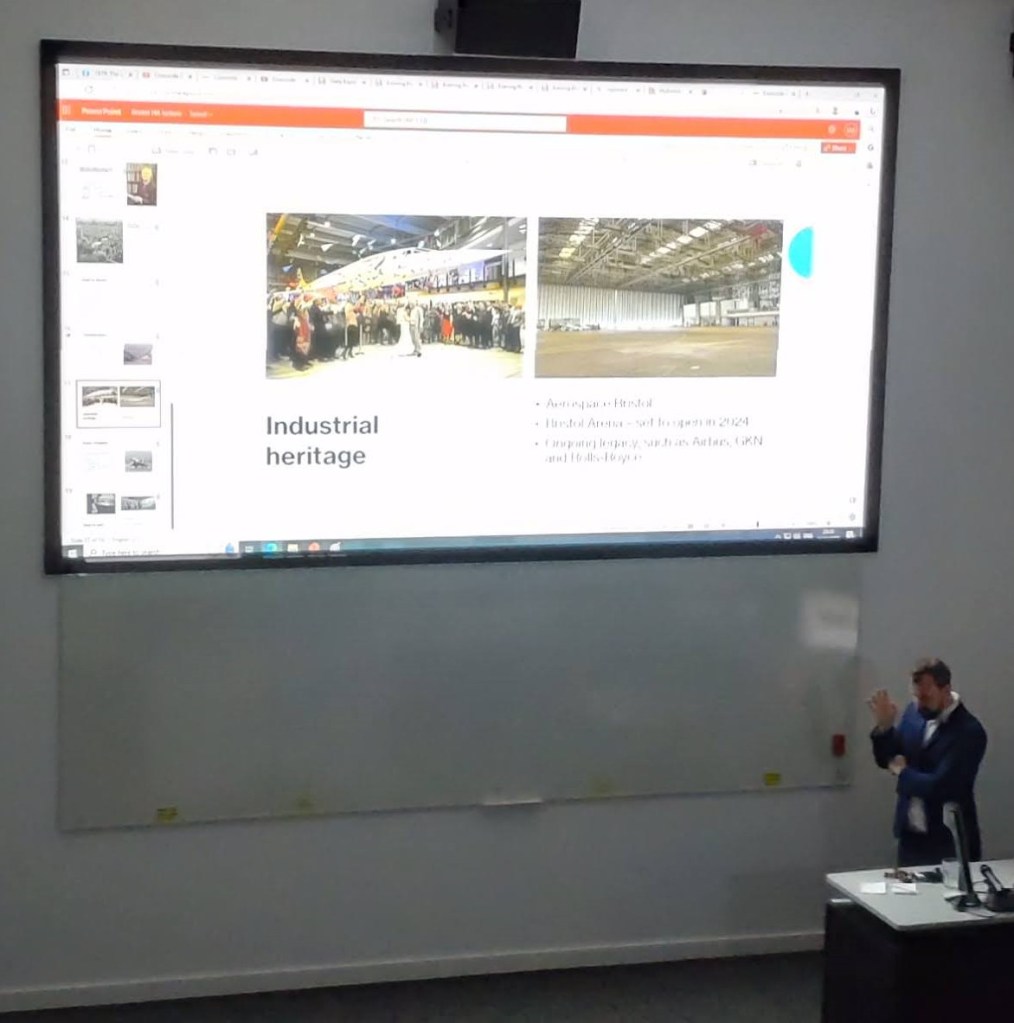
Dr McLoughlin’s talk looked at the emotional, economic and political links between Concorde and Bristol. The Bristol aircraft industry had always been at the forefont of the development of aeroplanes and engines. The Brabazon had led the way after the war. Its cancellation did not stop the company moving into the development of jet airliners. Concorde was prime minister Harold MacMillan’s way of showing that Britain was serious about Europe. The links between Filton and Toulouse led to some interesting cultural exchanges with engineers using imperial and metric measurements and Bristol workers trying to understand why you would have wine with your lunch. The 1974 Labour government were worried about the soaring costs of Concorde and of course it was Tony Benn (a Bristol MP) who fought to ensure it was not cancelled. There were some fabulous interviews with the workers (men and women) who, whilst they were passionate about Concorde, realised that they could never afford to fly in it. There was the story of Brian Trubshaw’s maiden flight with Concorde 002 in 1969 when there were several taxi runs before he decided to take off.
1969 saw the birth of the Boeing 747. Along with the 1973 oil crisis this led many airlines to cancel their orders. Ultimately 20 Concordes were built in Bristol and Toulouse. Seven flew for British Airways and seven flew with Air France. Four were used as development aircraft. In 2003 a Concorde flew back to Bristol and the story seemed to come to an end. In 2006, Concorde was announced the winner of the Great British Design Quest organised by the BBC and the Design Museum. A total of 212,000 votes were cast with Concorde beating other British design icons such as the Mini, mini skirt, Jaguar E-Type, Tube map, the World Wide Web, K2 telephone box and the Supermarine Spitfire
Dr McLoughlin would like to talk to anyone with memories of Concorde. There are many older Bristolians who may have worked at Filton or who witnessed the early flights. Please contact the Bristol Historical Association and we will pass on your contact details to Keith.
Alan Clarke gave an excellent talk to members on the Bristol Temperance movement. He covered why it had arisen, how the various organisations in Bristol grew, the footprint they had left on the city’s built environment and the politics behind the movement. Starting off with Hogarth’s vivid depiction of the gin craze versus healthy beer he went on to illustrate how temperance behaviour moved on to a movement of for total abstinence (tee-total) by the 1830’s. As cities grew and thousands of working class people poured out of the pubs each night there arose a desire for self-improvement combined with Evangelicalism as an alternative.
Beer Shops grew up which bypassed the JPs and the licensing laws in the 1830’s. Bristol as a city full of breweries, pubs and a long established wine trade developed a temperance movement to counteract this. Alan’s impressive research of street directories showed us the many branches of the Temperance Movement that evolved in the city and some of their leaders like Robert Charleston and JG Thornton.
The opening of Temperance Halls, Coffee Houses and Temperance Hotels as an alternative to pubs had left its footprint on the city. Alan had built up impressive maps of where these establishments had once existed. Many of the Temperance Hotels were close to the train station.
The Coffee Taverns were very much in the South and East of the City and much less in the North where the middle classes lived. Other signs of this temperance past were the drinking fountains around the city. The activities of the Temperance Movement included social outings and even football teams.
The political side of the temperance movement was fascinating. The Liberals were clearly damaged by their association with the idea of total prohibition. The Temperance Movement also left historians a picture of the drinking habits of Bristolians by counting the number of men, women and children leaving pubs across the city on a single night in 1881. Alan crammed an impressive amount of scholarship into his short lecture but for those wanting to know more there is pamphlet on sale from the ALHA.
BCfm Radio is offering paid commissions of £500 to local audio creatives and producers to develop work to celebrate the under-represented history of Bristoland surrounding areas.
In partnership with Bristol Cable, Bristol History Podcast and In The Dark, we seek to commission 5 local-based practitioners working in the areas of sound, radio, and podcasts to produce a short audio piece or documentary on an under-represented aspect of Bristol history.
Each practitioner will be asked to create a 15 minute audio piece or documentary which will be broadcast on BCfm and made available on podcast platforms through The Bristol Cable and Bristol History Podcast, and also to create a 5 minute version for an In The Dark sound event with a live audience.
Content: The audio piece or documentary must inform, educate and entertain listeners on an under-represented aspect of Bristol’s history, such as Women, Working Class, People of Colour, LGBTQ+, Disabled, a distinct Culture, Religion or Language, and Intersectionality.
We are particularly keen on pieces with strong Bristolian and West Country accents.
There is no standard style or format. We expect work that is unique and creative, that feels contemporary rather than historical and that work responds to theme in a modern context.
Practitioners will be paid a commissioning fee of £500. Additionally, up to £30 will be available for expenses. Practitioners will be paid on a freelance self-employed basis and will be responsible for their own tax and National Insurance.