Putin’s memory wars: The past as a weapon in Russia’s propaganda war against Ukraine  June 8th 2022

We had an audience of 45 last night at Janek Gryta’s lecture.

Dr Gryta’s fascinating and highly relevant lecture closed our year of lectures for 2021-22.  This lecture explored the way History is viewed not only in Russia but in Eastern Europe and has been shaped by the isolation of the Cold War and Communism.  This had led to a focus on a national victimhood/martyrdom view of the “Great Patriotic War” and a search for an enemy in the national narrative.  Poland’s Memory Law in 2016 which had temporarily forbidden saying that any Poles had participated in the Holocaust and Ukraine’s own law in 2015 were given as examples of how legislation had tried to enforce interpretations of the past.  In the main part of the lecture Dr Gryta looked at Vladimir Putin’s (ab)uses of History as an extreme case in the misuse of history.  He explored some of the exaggerated myths around the “Great Patriotic War” which portrayed Russians as the unequivocal saviours of the West.  Events like the Ribbentrop-Molotov Pact, the Katyn Massacres or the Holodomor (Famine in 1930’s Ukraine) were written out of the Russian narrative of History except for the brief spell in the 1990’s when the archives were opened.  Anyone who fought as nationalists in the Second World War is depicted as an anti-Communist and therefore a Nazi.  Stalin has now been praised by Vladimir Putin for expanding Russian borders.  The language and culture differences inside many of the former Soviet Republics were also explored and the effect of transporting Russian speakers to these areas. The lecture helped to give a much more sophisticated understanding of why Putin and his troops and TV audiences would accept terms like Nazi being applied to Ukrainians and how the invasion has been justified
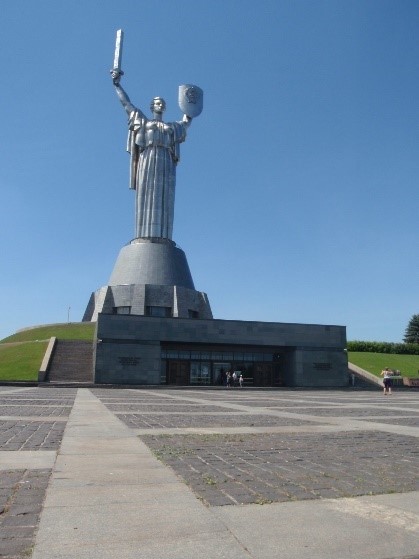
The Statue of the Motherland in Ukraine which still has the Hammer and Sickle on its shield

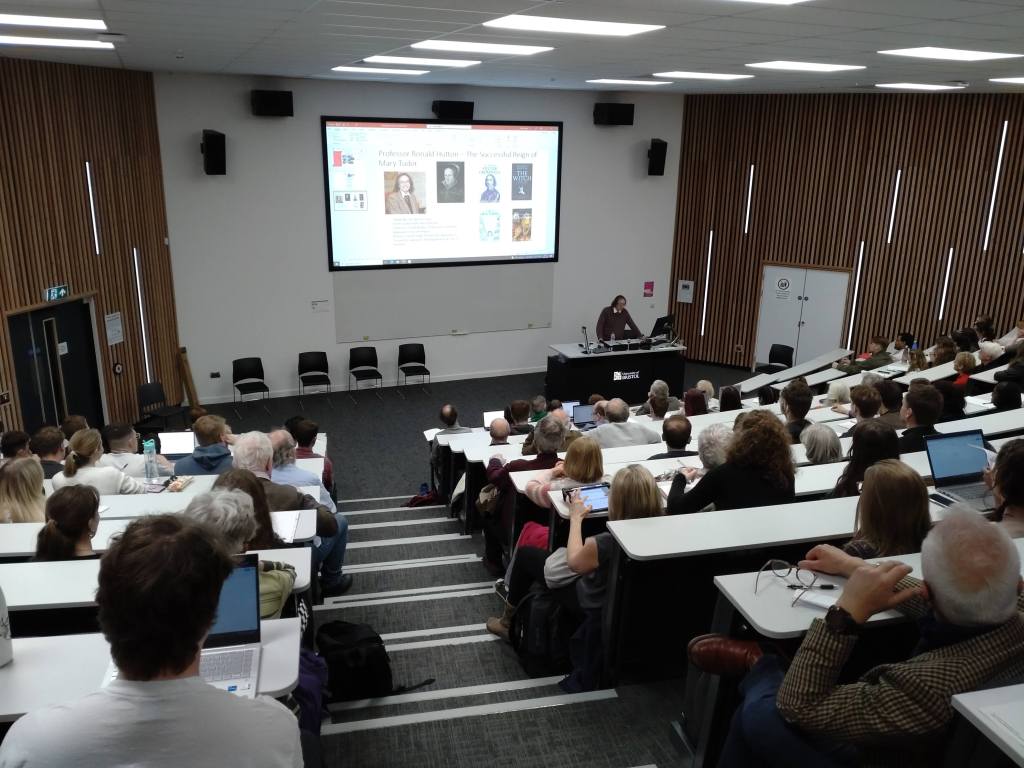
Professor Ronald’s Hutton’s Bristol Historical Association lecture 11th May 2022

The successful reign of Mary

We had our largest audience of 2021-22 so far, with 144 people including 95 students from 13 different sixth forms in the area.  Ronald Hutton delivered a clear revision of the “Bloody Mary” who is often seen as England’s most unpopular and least successful monarch.  Dividing the reign into four key areas -high politics, finance, defence and religion he re-examined her reign in line with research done by recent historians including himself.  The wasn’t a PowerPoint slide in sight as he developed his clear argument and the audience listened attentively.  He posed some really interesting comparisons with her sister along the lines of what if Elizabeth had reigned for an equally short period? He brought out her real achievements in managing her potentially faction ridden court, starting the road to financial recovery after the inflation of Edward and Henry’s reign and her lasting achievements in terms of defence in the setting up of a militia.  While acknowledging he did not find Mary a likeable personality, even in the area of religion and executions he gave a much more balance evaluation of Mary Tudor’s reign. By comparison Charles II’s record of tolerance was blighted by his incarceration of so many Quakers who died much slower deaths in squalid prisons. Ronald challenged the image of “Bloody Mary” as an exceptionally cruel monarch.  The striking conclusion was that there were no “duff Tudors” and they were all capable and talented rulers whether we liked them as people or not. This witty and lively lecture generated lots of great questions from our audience many of whom went off feeling more confident about their impending exams.   

Lunchtime lectures at Bristol central library

12.30pm until 1.20pm

Thursday May 12

A History of Bristol Medical School.

A Lunchtime Lecture by David Cahill.

Thursday 19 May

Praying in Medieval Bristol with the Ruddok-Clyve Hours.

A Lunchtime Lecture by Professor Kathleen Kennedy, University of Bristol.

Saturday 21 May

Take a tour of Bristol Central Library.

Thursday 26 May

Manson’s Bristol Miscellany

A Lunchtime Lecture by Michael Manson.

Thursday 26 May

Breaking The News. Extra! Extra. A behind the scenes viewing of historical newspapers from Bristol Libraries’ Collections.

The Beginnings of England.

Dr Marc Morris. Wednesday 23rd March 2022.

The Bristol HA’s ninth lecture of 2021-22 brought in our largest live audience with 55 people in the audience.  Marc Morris the bestselling medievalist condensed six hundred years of English History into an hour from a book that took him four and a half years to write.  He really gave us the big picture of the Anglo-Saxon period.  His talk was witty and very scholarly and challenged many of the myths some of us had learnt at school.  His very visual talk started with the collapse of Roman Britain. In a few generations a sophisticated economically specialized country with a professional army to defend it and civilian skills ranging from mosaic layers to shop keepers turned into a “fend for yourself” country ruled over by war lords.   Much of the evidence he presented across the centuries was derived from archaeological finds as much of what is in the Anglo-Saxon Chronicle and other later chronicles is based on legend. Among the key evidence drawn upon were the treasures at Sutton Hoo and Offa’s Dyke. He showed us the extensive coin evidence that Offa’s period had produced and how Offa had been influenced by Charlemagne. He also used maps to show us where up to 35 tribes in Anglo-Saxon England had been based. The arrival of the Vikings and their destruction of many of the written records was also explored. Alfred the Great of course appeared in the talk along with those famous cakes. He was described as Rex Anglo-Saxon, an English King but was not king of all the English. Even in the last century before the Norman Conquest it was clear that England was still coming together. We were left with a lasting impression that there are still many gaps in our knowledge of the Anglo-Saxons. Nevertheless, their legacy includes so many place names, the shires and of course the English language. The talk finished with lots of really informed questions from our audience and pithy answers from Marc.

IT’S GOOD TO BE (A)LIVE.

We’ve now done two live lectures in the large lecture theatre at 7 Woodland Road. We would like to reassure anyone that is slightly nervous about coming out that it is only a hop skip and a jump from the door at number 7 to the lecture theatre. The theatre is very large and gives ample room for social distancing. Parking in the nearby streets is free after 7pm. Hope to see you soon.

WE ARE GOING LIVE.

Our next event has been moved from Wednesday 16th February to Wednesday 23rd February. We will be in the lecture theatre at 7 Woodland Road. Dr Misha Ewen is coming from Brighton to talk about ‘Sugar, Silk & Slaves: English Women’s Participation in 17th Century Colonialism’

The lecture starts at 7.30pm but please arrive early. Members will need to sign in.