A SEX TOUR OF MEDIEVAL BRISTOL

Wednesday 4th August 2021. Dr Evan Jones.

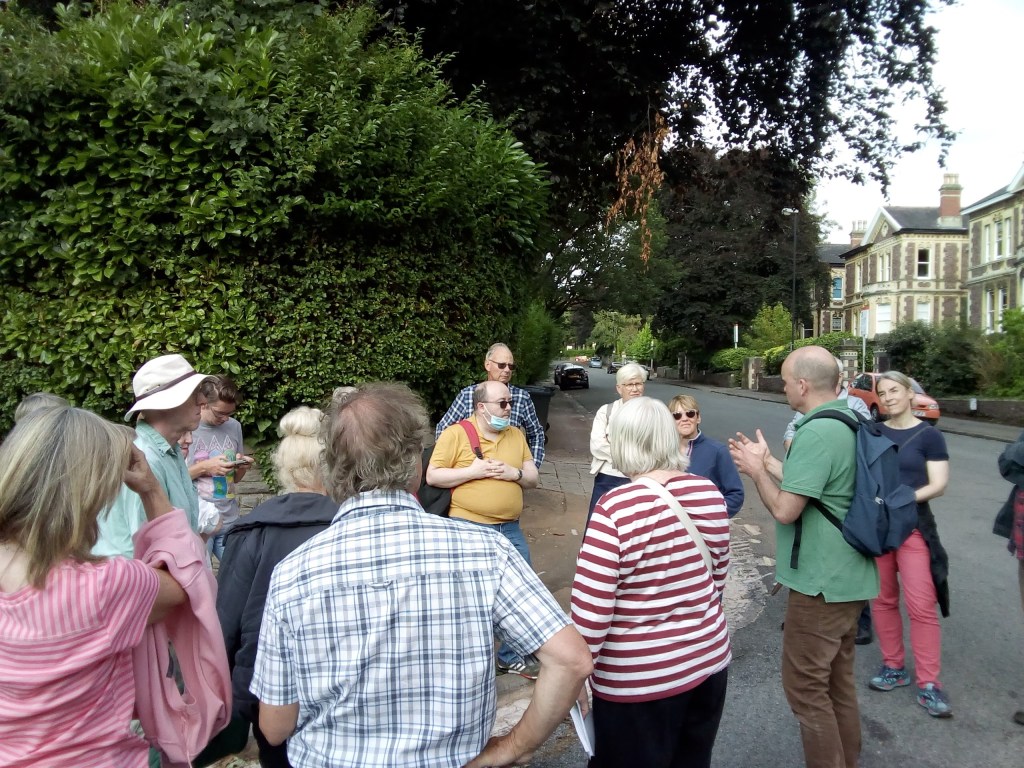
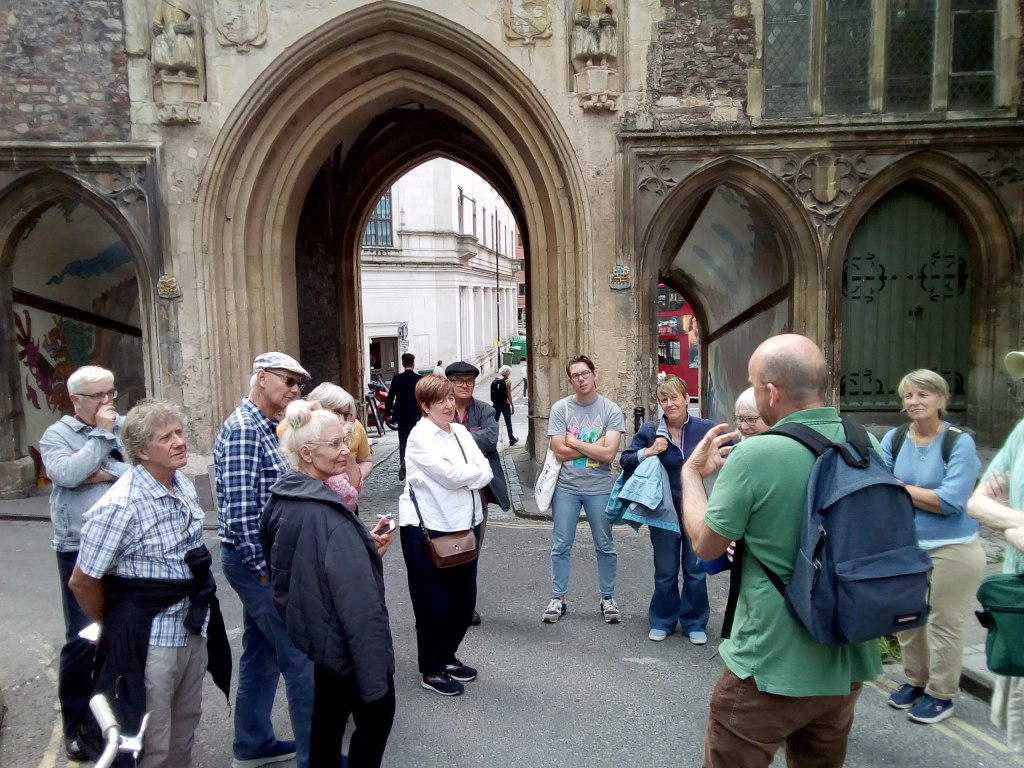
Dr Evan Jones provided a fascinating tour of the streets and groves to the north of the medieval city. His research has provided a fresh perspective on life in medieval Bristol. Nineteen Bristol HA folk attended. The official title of the tour was ‘From Grope Cunt Lane to Fucking Grove: a sex tour of medieval Bristol’

Evan began by St John the Baptist in Nelson Street. In the Middle Ages this street was called Grope Cunt Lane. The area was close to the ships docked at the Quay/Key head and so the local prostitutes had plenty of customers. Evan explained how words such as cunt had a somewhat different meaning. Nevertheless, by the eighteenth century the city fathers were becoming embarrassed by such street names and were looking for more respectable names. Nelson was a patriotic name and could be accepted by most Bristolians.

We moved on to St Stephen’s and discussed recent research into marriages in the parish. From there we moved on to Host Street (next to Christmas Steps) which had originally been called Whore Street. Once again, the city fathers sought to make it more respectable. Whore Street was changed to Horse Street and eventually Host Street.

From there we progressed to Park Row and talked about the garden houses/allotments that enabled some richer Bristolians to rise above the stench of the city below.

By the University Wills building and then Priory Road, Evan talked about the groves (Hither Fockynggrove and Inner Fockynggrove) that sat on the northern boundary of the 1373 City & County of Bristol boundary. Evan provided a map indicating the position of the county boundary stones. At least one of these has been found.

The groves were areas where couples could walk and talk and engage in more intimate activities away from the hustle and bustle of the city. Evan explained medieval and early modern attitudes to sex. Most couples had very little privacy. Beds and bedrooms were often crowded. Hence the attraction of the groves on the boundary with Gloucestershire.

The tour provided an intriguing picture of how sexual language and attitudes have changed in the last six centuries. It also gave us a tantalizing view of a side of Bristol that is now so different.

 The party retired to the Highbury Vaults.
New book. Bristol and Transatlantic Slavery : Origins, Impact and Legacy

Some of you will remember the meeting held by the Bristol Historical Association on 30th April where three leading Bristol history teachers talked about their forthcoming book. It’s finished.

You can buy it from the Bristol Museums Service for £11.95. Altough it is intended for use with school students it will be of interest to general readers of history.

Here is the link.

New novel set in Bristol at the time of Mary Tudor

The Unprofitable Servant [ISBN-10 ‏: ‎1838210377 and ISBN-13 : ‎978-1838210373] – is set in Bristol and its environs during the reign of Mary Tudor.  The basic theme of the story is that a little knowledge can be an extremely dangerous thing, particularly in the wrong hands.

Thanks to a great deal of media interest in the Tudors over the last few years everyone thinks that they know what happened during the reign of “Bloody” Mary.  Protestants were hunted down like dogs and burnt at the stake during a reign of terror which lasted five years.

The story is much more interesting than that, however.  Real people were in the grip of genuine concerns for their lives, their souls, their salvation, and over imaginings of what would happen to them in the afterlife.  Some were so concerned that they took matters into their own hands, following false preachers, blind to anything else.

Balancing these concerns was an ingrained need to obey their social and cultural superiors, copying them and, in their most private spaces mocking them.  It was in those places were these imperatives crossed where some of the best stories emerge.

The Unprofitable Servant (a novel based on real events) is set at the very start of the so-called “burning times” – when events in far off London were no more than horrific rumours.  The former (and very first) bishop of the diocese of Bristol, Lord Paul Bushe, is recalled into the service of his church by the second and much less experienced bishop who fears the repercussions for the city and region if rumours of an emerging sectarian problem in the Kingswood Forest are true.  Bushe reluctantly agrees to investigate, juggling official duties and personal objectives as he gets pulled back into a world and a life with which he thought himself finished.  As the reputed leaders of this sect are known to him personally, does he really have a choice?

Along the way, Bushe reminisces about his times as a bishop (serving one of England’s most important cities), and his time as a servant of the great Henry VIII and the boy Edward VI, as an agent of Thomas Cromwell, recalling the princess he once knew and the queen she has now become.

The main protagonist is a woman, a potential new Anne Askew named Margaret Burgess.  She is serious about her faith but unaware of the impact she is having on her husband John, his work, and their livelihood, as well as of the little prophecy group they host in the wool yards and dying houses of their little corner of England.  Bushe must find them, confront them, and save their souls before their antics bring down a rain of a royal hellfire which will burn everything in its path.

UNBUILT BRISTOL. Eugene Byrne. 12th May 2021.

We finished our 2020-21 season with an excellent illustrated talk by local historian and author Eugene Byrne. As a journalist Eugene has been able to observe at close hand the many schemes put forward by developers in Bristol over the last few decades. As an historian he can offer a longer term perspective of the many structures planned but not built over the last 250 years. He began of course with William Bridges’ 1793 design for a bridge over the Avon Gorge. It would have been breath taking. Eat your heart out Bath with your Pulteney Bridge!

Many of Bristol’s schemes have a habit of coming back to haunt us. The Severn Barrage was first planned in1849 but has re-emerged in 1920, 1933, 1943, 1967, 1773, 1981 and 2007. Eugene looked at the various plans for Bristol Docks, new road schemes and numerous ideas for Bristol Harbourside including the 1997 Harbourside Centre, 1999 Little Venice and the ill fated 2003 plan for the Bristol Arena. Of particular interest were the post war plans for Bristol that began in the middle of the Blitz in 1941 with the visionary City Architect John Nelson Meredith. There were many rival plans but the City Council’s 1945 plan included a bid for the compulsory purchase of 771 acres of land. In the end post war austerity limited the Council to four and a half acres. Nevertheless, we still got Broadmead, Castle Park (eventually) and many new road schemes. In the 1940s Bristol planners believed cars were the solution but by the 1970s Bristol was lamenting the loss of its tram system. From 1979 there have been a succession of plans for trams and supertrams starting with the Avon Metro. Today the Mayor is once again promising an underground. Eugene looked at recent ideas for the Castle Park/High Street site and alluded to the ongoing arguments about football stadiums.

A pattern emerged. During periods of prosperity engineers, planners and developers have big ideas but along comes a recession and the schemes are kicked into the long grass. In the debate that followed Eugene’s talk the audience offered conspiracy theories and pointed out structures that should never have been built. There was some agreement that a return to an Avon/Greater Bristol authority would solve some of Bristol’s planning problems.

Eugene’s book Unbuilt Bristol’ is available in all good bookshops. It should be compulsory reading for our Mayor, developers and planners.

Review of After the fall: Local teachers respond to the toppling of Colston. How to teach transatlantic slavery more effectively in Bristol

Richard Kennett, Sally Thorne & Kate Smee.

A talk followed by questions 28th April 2021

Last night’s talk by three gifted and committed local History teachers about teachers’ response to last summer’s events was an inspirational event in an exceptional year for the Bristol Branch of the HA.  Richard Kennett of Redland Green School put the project into context by discussing the emotions and reactions last summer’s toppling of Colston’s Statue and the Black Lives Matter Movement had aroused for the teachers of Bristol. They re-examined  their  teaching of this episode in Black British History and especially Bristol’s own History.  Sally Thorne Head of Humanities at Colston’s Girls School (soon to be renamed Montpelier High) explained the problems with a victim narrative of Black History that too often centred on the mechanics and the macabre elements rather than putting Black people at the centre of the story.  The problems with using source material that related to US History rather than the Caribbean were well established together with the unsuitability of using empathy and the silences or gaps that existed in much of the teaching of this topic before 2020.  Kate Smee Head of Humanities at Fairfield High School picked up the presentation by examining how this project established

  • A wider narrative including three continents with named locations not just generalisations
  • Put enslaved people at the forefront of the story and gave them agency
  • Put the focus on impact not just mechanics

Kate discussed in particular how teachers could also learn from their students about the experiences they had had of racism. She drew thought provoking parallels with the teaching of the Holocaust. Richard then explained how the book these teachers had written with support from the Museum, the City of Bristol and the University was produced in a very different way from the typical materials produced by publishers.  It had been peer reviewed by academics with specialist knowledge every step of the way, with particular mention of one of our speaker’s this year Dr Richard Stone.  It had also been peer reviewed by Black teachers and local History teachers of different political outlooks.  There was a really enthusiastic and lively discussion by the audience after the talk.  It was clear many could not wait to read this textbook and use it with their students. The book is being published this summer and Richard, Kate and Sally are giving a talk about the project at this summer’s National HA Conference. Today Rob received lots of feedback from members who are no longer teachers who were just as excited by the talk.

Mary Feerick BRISTOL HISTORICAL ASSOCIATION

Dr Su Lin Lewis. Protest & Education in Burmese History

Dr Lewis of Bristol University is a specialist in twentieth century global and transnational history particularly in South and South East Asia. She gave a very relevant and topical talk about the historical roots of protest in Myanmar which she traced back to the late nineteenth century and British Colonialism.  She used little seen photographs of Rangoon University and its students to describe the culture of the 1920’s-1940’s and some of those students who became leaders of the Nationalist movement including Aung San Suu Kyi’s father Aung San who was Myanmar’s first democratic leader and founder of the Burmese Army.  The lively atmosphere at Rangoon University in the interwar period with its mixture of female and male students was fascinating. The talk linked these nationalist protests by students to the much more recent events in which Aung San Suu Kyi emerged as a national icon. It also stressed the part played by thousands of ordinary people (many in education) in these protests and what they had suffered as a result. 

The audience of thirty asked many questions at the end of the talk on a topic we all felt was highly relevant not only because of the protests in Myanmar but also because of the role of the young in protests in our own country.

Dr Richard Stone Detective of the Slave Trade – “An academic with a laptop on the shoulder of giants

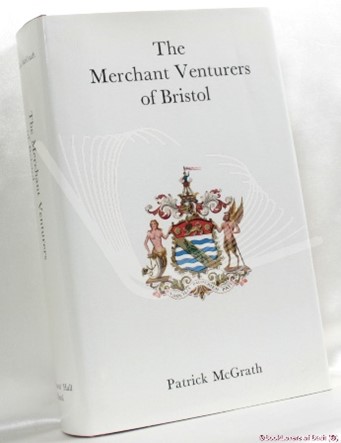
Last night Dr Richard Stone gave a fascinating lecture on Bristol’s First Slave Traders.  Not only did we learn so much that was new about the topic many Bristolians think they already know all about, but again we learnt about how historians use and interrogate evidence. Richard had used the Customs Records of the docks, the Port Books, to trace the changes in trade that showed that slave trading was going on in Bristol long before the monopoly of the Royal African Company was abolished in 1698.  Tell-tale clues including cargoes containing glass beads and felt hats suggested slave trading.  Using spread sheets and pie diagrams Richard pinned together the trail of slave trading voyages but he also showed he had walked in the footsteps of other historians of Bristol including Professor Charles M MacInnes, “Mac” and Professor Paddy McGrath “giants” in researching the History of the City and also the work of Professor Madge Dresser whose knowledge of the social and cultural aspects of slavery complimented his own forensic analysis of these long neglected written sources. 

It was a brilliant talk which sparked off both lively questions and some very knowledgeable comments from our audience. The success of the talk is shown by another large audience and some appreciative texts and tweets, notably from Professor McGrath’s daughter Antonia one of our original members of 2017 “my father would have been delighted to know the type of research he is involved in and his methodical approach” and two tweets on the HA National website this morning from Richard Kennett and Dr Jo Edwards

Just watched @Dr_RGStone deliver the @BristolHA lecture on Bristol’s 17th century slave voyages. So interesting. A genuinely brilliant lecture explaining the historical process and sifting the archives to find evidence of illegal voyage

Superb @BristolHA lecture on the evidence of trade of enslaved people by Bristol merchants pre-1698. Particularly enjoyed the details on methodologies and explained historiography. A greatly talented and entertaining speaker – thanks @Dr_RGStone. PS finish that book!

I think many of us would agree with Jo we are dying to read Richard’s book when it comes out.

Henry VII. Our largest Zoom event yet.

With our largest Zoom audience so far (140 souls), our Branch had an amazingly comprehensive lecture on Henry VII on 24th February.  Henry VII’s isolated childhood and weak claim to the throne, his path to 1485 and his long battle to ward off threats after his succession were explored in fascinating detail by Dr Cunningham.  As an archivist he accompanied his lecture with a lovely mixture of illustrations from Ladybird books, contemporary art featuring Henry and his closest collaborators and rare late medieval manuscripts.  The tragedy of how Henry’s long reign was dogged by family tragedy once he had shaken off threats of imposters and how he wore out his own closest advisers in his need to tighten his hold on his country was brought out in fascinating detail.  This was a King who never got to enjoy his power but built a dynasty.   After the lecture Sean was happy to deal with some very well informed questions from our audience mostly from A level students and undergraduates who really appreciated this lecture.